Chiller Refrigerant Transition: R-123, R-134a, and Beyond
Large commercial chillers — the centrifugal and screw machines that carry cooling loads in hospitals, data centers, universities, and office towers — are now caught between two regulatory tides. The Montreal Protocol's long-running HCFC phaseout has all but eliminated new R-123, while the AIM Act's HFC phasedown is tightening lawful supply of R-134a year by year. This guide walks facility managers, chief engineers, and compliance officers through how to map their fleet, weigh refurbishment against replacement, and stay on the right side of 40 CFR Part 84 Subpart C while making 15-year capital decisions.
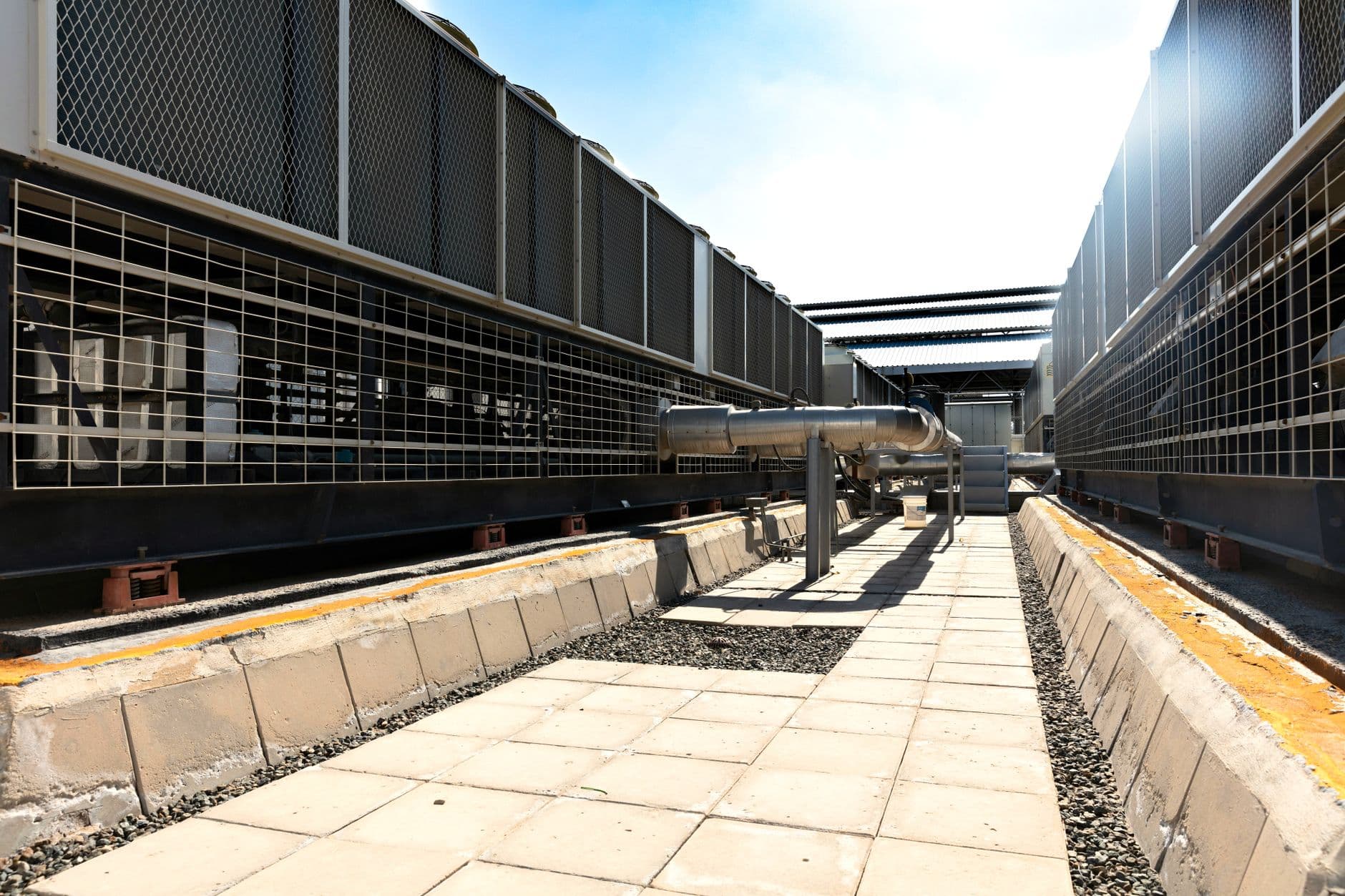
Photo by Tayssir Kadamany on Pexels
Why Chillers Sit in Their Own Compliance Category
Subpart C's leak repair regime under § 84.106 and the automatic leak detection rules under § 84.108 apply broadly across the regulated equipment population. Chillers, however, present a combination of factors that make them uniquely difficult to plan around: capital costs that run from several hundred thousand to several million dollars per unit, design lives of 20 to 30 years, refrigerant charges measured in hundreds or thousands of pounds, and operating profiles that often can't tolerate extended outages.
The two refrigerants dominating the installed base — R-123 in older low-pressure centrifugal machines and R-134a in newer medium-pressure centrifugal and screw chillers — are on different regulatory tracks but converging toward the same outcome. R-123 is an HCFC governed by Title VI of the Clean Air Act and the Section 608 program. R-134a is an HFC governed by the AIM Act and the Part 84 framework. The mechanical engineering reality is that both classes of chiller will need a path forward — refurbishment with a drop-in or near-drop-in replacement, conversion to a new low-GWP refrigerant, or outright replacement — before the end of the next capital cycle.
What follows is a practical framework. It is not a substitute for a mechanical engineering assessment of your specific equipment, but it should help structure the conversation with your service contractor, your chiller OEM, and your CFO.
Mapping the Installed Base: R-123, R-134a, and the Refrigerants Replacing Them
Before you can plan a transition, you have to know what you have. Most multi-building portfolios contain a mix of generations. Understanding what each refrigerant is, why it was chosen, and what the successor chemistry looks like is the first step.
| Refrigerant | Class | Typical Chiller Type | GWP (AR4) | Status |
|---|---|---|---|---|
| R-123 | HCFC | Low-pressure centrifugal | 77 | Production phased out for new equipment; service supply contracting |
| R-134a | HFC | Medium-pressure centrifugal, screw | 1,430 | AIM Act phasedown; allocation declining toward 2036 |
| R-1233zd(E) | HCFO | Low-pressure centrifugal (R-123 successor) | ~1 | Non-flammable; commercially deployed in new low-pressure chillers |
| R-1234ze(E) | HFO | Medium-pressure centrifugal, screw (R-134a successor) | <1 | A2L (mildly flammable); used in new low-GWP chillers |
| R-513A | HFC/HFO blend | Medium-pressure centrifugal, screw (R-134a near-drop-in) | 631 | A1 non-flammable transitional option; still HFC-blended |
| R-514A | HFO blend | Low-pressure centrifugal (R-123 conversion) | ~2 | B1 toxicity class; manufacturer-specific deployment |
A few practical observations. R-1233zd(E) is non-flammable (ASHRAE A1) and has emerged as the dominant successor for low-pressure centrifugal machines. R-1234ze(E) is mildly flammable (A2L) which drives ASHRAE 15 machinery-room requirements that did not previously apply, and that's a meaningful design constraint for retrofits. R-513A is sometimes pitched as an R-134a "drop-in," but it still contains R-134a as a major component and therefore remains subject to the same HFC phasedown pressure on a delayed schedule.
How Subpart C Applies to Chillers Specifically
Two sections of Subpart C drive the day-to-day compliance picture for chillers: § 84.106 (leak repair) and § 84.104 (substance management, reclamation, and recovery). They interact with the operational realities of chiller service in ways worth flagging.
§ 84.106 — Leak Repair Applicability
Section 84.106 applies to appliances with a full charge of 15 pounds or more of a regulated substance or a substitute with a GWP above 53. Virtually every commercial chiller clears that bar. The applicable leak rate threshold depends on the equipment category — comfort cooling chillers are subject to a 10% annual leak rate trigger, while industrial process refrigeration sits at 30% and commercial refrigeration at 20%. For a 500-pound R-134a centrifugal serving an office tower, that means a recorded loss of 50 pounds in a rolling 365-day window starts the repair clock.
For a fuller treatment of the applicability rules, see the § 84.106(a) applicability threshold guide and the dedicated walkthrough of leak repair compliance under § 84.106.
§ 84.104 — Substance Management and Reclamation
Section 84.104 is the substance-management spine of Subpart C. For chiller operators it does two important things. First, it carries forward and extends the Section 608 reclamation framework — recovered R-134a and other regulated substances cannot lawfully be resold to a new owner unless an EPA-certified reclaimer has processed the material to AHRI Standard 700 purity. Second, it makes the equipment owner responsible for ensuring that any technician servicing the chiller is Section 608 certified and that recovery is performed using certified recovery equipment.
Practically: if you pull a 1,200-pound R-134a charge out of a screw chiller during a major overhaul, you cannot stockpile that recovered gas indefinitely and resell it to a sister property. The recovered material either needs to be sent for reclamation, used by you in like-kind equipment, or destroyed by a certified destruction facility. The recordkeeping obligation under § 84.106(l) extends to the chain of custody for that recovered refrigerant.
What this means for chiller fleets: the higher the per-machine charge, the higher the dollar value of the recovered refrigerant, and the higher the audit exposure if the chain of custody is incomplete. A misplaced cylinder log on a chiller refit is not a paperwork problem — it can be a material enforcement finding under § 84.106(l).
Centrifugal vs Screw Chillers: Different Machines, Different Transition Paths
Lumping all large chillers together is a planning mistake. The mechanical differences between centrifugal and screw machines drive materially different refrigerant transition options.
Centrifugal Chillers
Centrifugal chillers use a high-speed impeller to compress refrigerant vapor. They're the dominant choice for large tonnages, especially above 300 tons. Their performance is sensitive to refrigerant volumetric flow and the speed of sound in the working fluid — which means you typically cannot substitute a different refrigerant without changing the impeller. That is why R-123 to R-1233zd(E) conversions on existing centrifugals require either an impeller swap or an OEM-specified conversion kit. The same is true for R-134a to R-1234ze(E).
Low-pressure centrifugals using R-123 are particularly affected. Because R-123 operates below atmospheric pressure on the evaporator side, the entire machine is engineered around containing and managing a vacuum — purge units, special seals, and unique service procedures. Migrating these machines to R-1233zd(E) is generally feasible because the two refrigerants have similar thermodynamic properties, but it remains an engineered conversion, not a swap.
Screw Chillers
Screw chillers use a positive-displacement compressor and tolerate a wider range of refrigerant properties. That makes them more forgiving for transitional blends like R-513A. However, screw machines moving to R-1234ze(E) face the same A2L flammability considerations as centrifugals: machinery-room ventilation, leak detection thresholds, and electrical classification all need attention.
Screw chillers under 300 tons are also the segment where complete replacement with a packaged low-GWP unit often pencils out better than retrofit. The depreciated value of the existing machine is lower, the new machine carries an OEM warranty under the new refrigerant, and the disruption is bounded.
Refurbishment vs Replacement: How the Economics Actually Pencil Out
The question facility teams keep arriving at is the same: do we convert this chiller or replace it? There is no universal answer, but there is a workable framework. The variables that actually matter are remaining useful life, current refrigerant charge size, retrofit complexity, and forecast refrigerant supply through the end of the planning horizon.
| Scenario | Lean Toward | Why |
|---|---|---|
| R-123 centrifugal > 20 years old; OEM conversion kit available | Replacement | Depreciated machine, high refurbishment risk, modern efficiencies are materially better |
| R-123 centrifugal 10–15 years old; well maintained | Conversion to R-1233zd(E) | Significant remaining life; OEM-engineered conversion generally cost-effective |
| R-134a screw < 10 years old | Maintain, plan replacement for late 2030s | Allocation supports continued service; capital not justified yet |
| R-134a centrifugal 15+ years old serving mission-critical load | Replacement with R-1234ze(E) machine | Reliability risk dominates; new equipment carries OEM warranty and full machinery-room compliance |
| R-134a screw with high recurring leak rate | Replacement | Leak repair escalation under § 84.106 likely triggers retrofit/retirement obligation regardless |
Two underappreciated cost categories often flip the math. The first is refrigerant supply price risk. As AIM Act allowance allocations contract, the spot price of R-134a will rise and become more volatile. A 1,000-pound charge that costs $X today may cost $2X or $3X by the late 2020s. Owners running a quietly high-leak-rate fleet are exposed to this risk in a way that doesn't show up on a depreciation schedule. The second is the compliance overhead of ongoing service — § 84.106(l) recordkeeping, § 84.108 ALD for any covered units, and the increasing scrutiny of refrigerant sourcing. New equipment doesn't eliminate those obligations, but it does reset the leak baseline and generally simplifies them.
For a parallel framework specifically focused on the AC side, see our walkthrough of R-410A replacement options under Subpart C.
Useful-Life Planning Under the HFC Phasedown
The AIM Act sets a stepped reduction in HFC consumption allowances: 10% baseline reduction (already implemented), 40%, 70%, and ultimately 85% by 2036. That schedule matters because R-134a is one of the highest-volume HFCs in the regulated basket. Each step down tightens lawful supply and re-prices what remains. A useful-life planning exercise for a chiller fleet has to overlay that schedule onto each machine's remaining service life.
A Practical Approach to Fleet Mapping
For each chiller in your portfolio, capture the following data points and arrange them on a timeline. The output is a roadmap that shows when each unit is most vulnerable to the supply curve and when replacement capital should be programmed.
- Refrigerant type and full charge size in pounds — the charge size drives both Subpart C applicability and refrigerant supply exposure.
- Installation date and estimated remaining useful life — most centrifugals are designed for 25–30 years; screw chillers typically 20–25 years.
- Trailing 24-month leak rate — units consistently running above 5% annual leak rate are at elevated risk of triggering § 84.106 repair obligations and warrant earlier replacement consideration.
- OEM conversion or retrofit kit availability — if the original manufacturer has published a documented conversion path, that significantly de-risks a refurbishment decision.
- Service-criticality of the load — chillers supporting data center cooling, hospital surgical suites, or process-critical manufacturing have different tolerance for outage windows than office cooling.
- Machinery-room configuration — if migrating to an A2L refrigerant like R-1234ze(E) would require significant ventilation, electrical, or sensor upgrades, those costs need to be in the comparison.
Decision-window heuristic: the rougher the remaining useful life and the larger the charge, the earlier the replacement window should open. A 30-year-old, 2,000-pound R-123 machine should be treated as a near-term capital project. A 5-year-old, 400-pound R-134a screw chiller probably stays in service through its design life with disciplined leak management.
Compliance and Recordkeeping During a Chiller Transition
A chiller conversion or replacement is not a paperwork-free event. Subpart C imposes documentation obligations that begin the day the decision is made and continue for three years after equipment retirement. Common failure modes during transitions:
- Recovered refrigerant chain of custody. The high-value charge pulled out of a converted or retired chiller must be tracked from recovery cylinder through reclamation (or destruction) under § 84.104. Missing cylinder serial numbers or undocumented transfers are routine findings in EPA inspections.
- Final leak rate calculation at retirement. If the retiring chiller had been carrying an exceedance, the obligation to document the resolution does not disappear with the equipment. The recordkeeping window under § 84.106(l) runs three years past the retirement date.
- New equipment commissioning records. The replacement chiller's full charge, refrigerant identity, install date, and initial leak test results become the baseline for all future § 84.106 calculations on that unit.
- Service contractor certifications. Both Section 608 technician certification and recovery equipment certification need to be on file. For A2L refrigerants like R-1234ze(E), there are additional handling considerations even though Section 608 applies.
- Allowance-holder verification for new refrigerant purchases. The replacement charge — typically delivered in ISO containers for large machines — should be sourced from an EPA-authorized allowance holder with documentation. See our guidance on counterfeit refrigerants and procurement due diligence.
For multi-building portfolios running chiller conversions across several years, spreadsheet-based recordkeeping tends to break down quickly — every conversion adds five to ten new compliance artifacts per machine, and the data needs to be retrievable in audit-ready form for a decade or more. RefriTrak™ is a refrigerant compliance platform that captures the per-cylinder, per-machine chain of custody Subpart C now expects — useful when a single conversion project might generate dozens of cylinder events on a single asset. It is software, not consulting; it sits where recordkeeping has historically been the weak link in chiller transitions.
What a 10-Year Chiller Transition Roadmap Looks Like
The following is illustrative — every portfolio is different — but it shows how the regulatory schedule, the supply curve, and the mechanical realities can be combined into a coherent multi-year plan.
Years 1–2: Inventory and Triage
Complete a full chiller-by-chiller inventory with refrigerant type, charge size, age, leak history, and OEM-supported conversion paths. Tag every machine with a preliminary disposition: maintain, convert, or replace. Address any units already triggering § 84.106 repair obligations first.
Years 2–4: Near-Term Capital
Execute on the oldest, highest-charge R-123 and R-134a units — the ones with the worst supply exposure and the lowest depreciated value. This is where most replacement spending should concentrate. New equipment should be specified on a low-GWP refrigerant unless there is a compelling reason to install another HFC-charged machine.
Years 3–6: Mid-Fleet Conversions
For chillers in the middle of their useful life with strong leak records, this is the window for OEM-engineered refrigerant conversions where they pencil out — typically R-123 to R-1233zd(E) on existing low-pressure centrifugals.
Years 5–10: Roll-off of Remaining HFC Units
By the late 2030s, the AIM Act schedule will have reduced HFC consumption allowances by 85% from baseline. Any R-134a machine still in service at that point should be on a documented end-of-life plan. The supply that does exist will be expensive and increasingly directed toward servicing equipment that cannot be replaced.
The roadmap is iterative, not static. Each annual review should revisit the disposition tags based on the prior year's leak performance, refrigerant pricing, and any updates to EPA guidance or AIM Act allocation rules.
Enforcement Context: Why Chiller Owners Are a Visible Target
Large stationary refrigeration and air-conditioning systems carry high per-event refrigerant releases and concentrated regulatory interest. The combination of high charge sizes, long service lives, and shared service contractors makes chiller fleets attractive targets for compliance review. EPA has pursued enforcement actions across the commercial refrigeration sector under the predecessor Section 608 program, and Part 84 carries that posture forward.
The penalty exposure is meaningful. Under 42 U.S.C. § 7675(k), AIM Act violations of Subpart C carry civil penalties on a per-day, per-violation basis. The independent Clean Air Act civil penalty maximum is currently $124,426 per day per violation (inflation-adjusted). For a fleet of chillers with documentation gaps across multiple machines, the daily-penalty math compounds quickly. For the full enforcement framework, see our reference on Subpart C enforcement penalties.
The good news is that chiller-focused compliance is largely mechanical. The fleet is finite, the equipment is well-instrumented, and the regulatory expectations are documented. Owners who invest in inventory accuracy, leak-rate visibility, and chain-of-custody discipline rarely end up in difficult enforcement conversations.
Frequently Asked Questions
Is R-123 banned under 40 CFR Part 84?
R-123 is an HCFC and is primarily governed by Title VI of the Clean Air Act, not Part 84 (which targets HFCs and substitutes). Production of R-123 for new equipment has been phased out under the Montreal Protocol; limited service-tail supply remains. Part 84 Subpart C's leak repair and recordkeeping obligations still apply to R-123 chillers as covered appliances, because the section reaches both regulated substances and substitutes with applicable GWPs.
Can I keep buying R-134a after the next AIM Act allowance step down?
Yes, but at higher cost and with greater supply risk. AIM Act allowances reduce the total volume of HFCs that can be produced or imported lawfully, not the act of purchasing existing inventory. As allocations tighten, allowance-holder pricing rises and unallocated product becomes scarcer. Reclaimed R-134a processed by EPA-certified reclaimers also remains lawful and will represent an increasing share of the service market.
What is the difference between R-1234ze(E) and R-1234yf?
Both are HFOs with very low GWP, but they target different applications. R-1234yf is the dominant low-GWP refrigerant in automotive air-conditioning. R-1234ze(E) is used in commercial chillers and certain industrial applications. Both are ASHRAE A2L (mildly flammable) and both impose machinery-room safety considerations that R-134a did not.
Can a chiller be converted from R-134a to R-1234ze(E) without replacing the compressor?
For centrifugal machines, the impeller is typically tuned to the refrigerant's thermodynamic properties, so a switch to R-1234ze(E) usually requires an OEM-engineered conversion that includes new impeller and possibly motor adjustments. Screw chillers can be more forgiving but still require manufacturer sign-off. Owners should not undertake refrigerant substitution without the OEM's documented conversion package and SNAP-listed approval for the application.
Does Subpart C require automatic leak detection on chillers?
Section 84.108 ALD applies to industrial process refrigeration and commercial refrigeration appliances with a full charge of 1,500 pounds or more and a regulated GWP above 53. Comfort cooling chillers — the typical office, hospital, university, and data center chiller — are exempt from § 84.108 regardless of charge size. They remain subject to § 84.106 leak repair requirements. For the full detail, see our automatic leak detection guide.
How long do I have to retain records after retiring a chiller?
Under § 84.106(l), records must be retained for at least three years after equipment retirement or disposal. This includes leak rate calculations, service tickets, refrigerant addition and recovery logs, and the chain-of-custody documentation for the final refrigerant recovery event. See the dedicated § 84.106(l) recordkeeping guide for full details.
Related Resources
- Leak Repair Compliance Under § 84.106 — How the leak rate, repair clock, and verification obligations apply to large stationary equipment.
- Automatic Leak Detection Under § 84.108 — Applicability thresholds, technology options, and how ALD interacts with manual inspection obligations.
- The AIM Act HFC Phasedown Schedule — Year-by-year allocation reductions and what they mean for HFC supply.
- Retrofit vs Retirement Decisions — The § 84.106 framework for what happens when leak repair fails.
- R-410A Replacement Options — The companion analysis for split-system and packaged AC equipment.
Sources
- eCFR — 40 CFR § 84.106 (Leak Repair)
- eCFR — 40 CFR § 84.104 (Substance Management)
- eCFR — 40 CFR § 84.108 (Automatic Leak Detection)
- EPA — AIM Act Overview
- EPA — Frequent Questions on the HFC Phasedown
- EPA — Significant New Alternatives Policy (SNAP) Program
- EPA — Stationary Refrigeration and Air Conditioning (Section 608)
- 42 U.S.C. § 7675 — AIM Act Statute
- ASHRAE Standards 15 & 34 — Refrigerant Safety Classification and Machinery Room Requirements