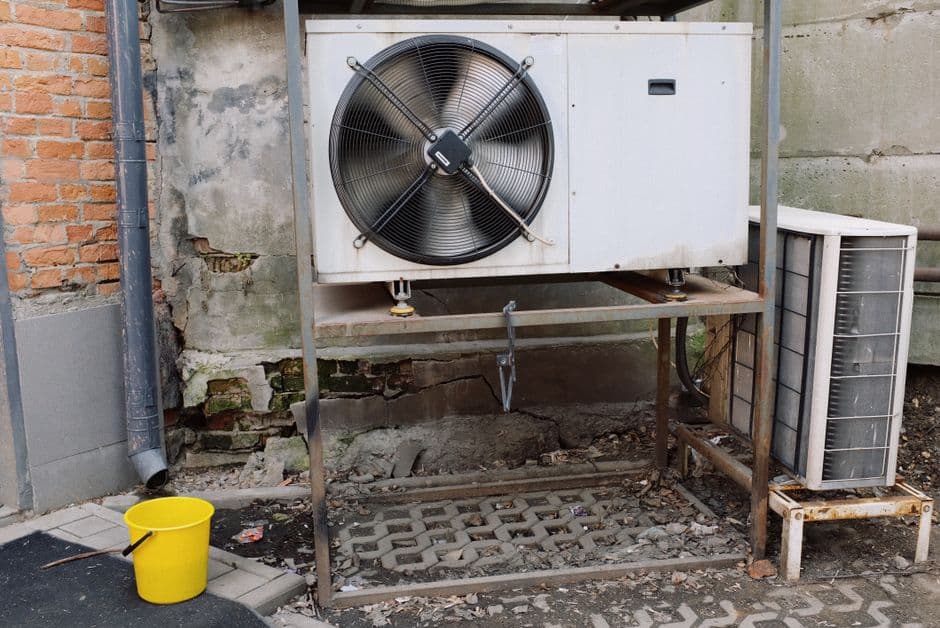
Photo by ready made on Pexels
R-410A Replacement Guide: AIM Act Compliance for Facility Planners
R-410A is still running in millions of commercial HVAC systems, but the regulatory and market environment around it has shifted permanently. New equipment using R-410A cannot legally be manufactured, R-410A prices are rising, and existing systems are now subject to federal leak-repair obligations under 40 CFR § 84.106. This guide covers what changed, what replacements are approved, and what facility planners need to do now.
Why R-410A Is Being Phased Down: The AIM Act and Kigali Framework
The American Innovation and Manufacturing (AIM) Act of 2020 directs EPA to reduce U.S. HFC production and consumption 85% by 2036, implementing obligations under the Kigali Amendment to the Montreal Protocol — ratified by the Senate in September 2022. The AIM Act HFC phasedown schedule and baseline year allowances set out the stepdown trajectory facility planners should use for long-range capital planning.
R-410A carries a global warming potential (GWP) of 2,088 — roughly 40 times the GWP ceiling the market is moving toward — which placed it among the first refrigerants targeted by the phasedown schedule. Manufacturers were prohibited from producing or importing new R-410A residential and light-commercial HVAC equipment after January 1, 2025; new commercial rooftop and split systems follow the same cutoff date.
Critically, existing R-410A systems are fully grandfathered. No mandatory replacement deadline applies to operating equipment — but compliance obligations for those systems are real and active, as covered below.
Current Regulatory Status: What Changed in 2025–2026
EPA's May 2026 final reconsideration rule removed the January 1, 2026 installation deadline for pre-2025 R-410A inventory, allowing contractors to clear remaining stock without enforcement risk. An EPA enforcement discretion statement from December 2025 confirmed that installation-ban provisions were a low enforcement priority during rulemaking. Facility planners should not treat this as a permanent reprieve — the underlying phasedown trajectory continues.
For supermarkets and retail food refrigeration, EPA temporarily raised the allowable refrigerant GWP ceiling to 1,400 from January 1, 2027 through January 1, 2032 before lower limits take effect, providing a longer transition window for cold-chain operators.
The November 2025 Federal Register notice on 2026 allowance allocations and the August 2025 rule reviewing application-specific allowances both signal that the EPA is actively tightening the supply of high-GWP refrigerants, and that price pressure on R-410A service refrigerant will continue.
California adds a separate layer: CARB's R4 program requires VRF manufacturers to source 25% of refrigerant from reclaimed stock annually as of 2025.
Approved Low-GWP Replacements for New Equipment
EPA's SNAP program lists accepted substitutes by end use. Facility planners must verify that a specific substitute is listed for their exact application category before specifying equipment.
| Refrigerant | GWP | Safety Class | Primary Applications |
|---|---|---|---|
| R-454B | 466 | ASHRAE A2L | Residential and light-commercial splits, rooftop units |
| R-32 | 675 | ASHRAE A2L | Mini-splits, VRF systems |
| R-466A | ~733 | A1 (non-flammable) | Applications where A2L constraints are prohibitive; limited availability |
R-454B has been selected by most major manufacturers — Carrier, Trane, Lennox — as the primary drop-in successor for residential and light-commercial systems. R-32 delivers up to 12% better energy efficiency than R-410A and is dominant in mini-split and VRF product lines. R-466A remains under evaluation for settings where A2L flammability classification is a barrier, though market availability is limited as of 2026.
A2L Safety and Building Code Implications for Facility Planners
Both R-454B and R-32 are classified ASHRAE A2L — mildly flammable. This classification triggers requirements under ASHRAE Standard 15-2022 for upgraded mechanical room ventilation, refrigerant detection systems, and emergency shutdown integration.
The infrastructure impact can be significant. A chiller room transitioning from R-410A to R-454B may require minimum exhaust capacity to increase from roughly 775 cfm to 9,000 cfm. That is not a drop-in swap — it requires coordinated mechanical, electrical, and controls work planned well ahead of equipment delivery.
Local jurisdictions adopting the 2024 International Mechanical Code (IMC) or later incorporate A2L requirements directly into permit review. Confirm the applicable local code edition before specifying new equipment to avoid mid-project change orders.
Service technicians must use A2L-rated gauges, manifolds, and recovery equipment. Verify contractor tooling compliance before awarding service contracts for new low-GWP systems — and document that verification in your Subpart C records.
Existing R-410A Systems: Subpart C Compliance Obligations That Apply Now
As of January 1, 2026, any appliance containing 15 or more pounds of a refrigerant with GWP above 53 — which includes all R-410A commercial equipment — is subject to 40 CFR § 84.106 leak-repair requirements. See the EPA's January 2026 leak repair fact sheet for a plain-language summary.
The mandatory repair thresholds by equipment category:
- Comfort cooling — repair obligation triggered at 10% annualized leak rate
- Commercial refrigeration — triggered at 20%
- Industrial process refrigeration — triggered at 30%
Repairs must begin within 30 days of exceeding the threshold (120 days if an industrial process shutdown is required). If repairs fail, owners must produce and execute a retrofit or retire decision triggers under § 84.106 within 30 days, completed within one year.
Records — full charge amounts, service dates, refrigerant quantities added or removed, and calculated leak rates — must be retained for at least three years and available for EPA inspection on demand.
Retrofit vs. Replace Decision Framework
Equipment under 10 years old in good mechanical condition is generally a retrofit candidate — but evaluate OEM compatibility documentation before assuming R-454B can be used in an existing R-410A system. Field retrofits are not universally supported, and an incompatible retrofit can void the equipment warranty.
Equipment over 12–15 years old with a high service history, escalating leak rates, or approaching the retrofit-or-retire trigger under § 84.106(f) should be evaluated for full replacement with new A2L-charged equipment. The compliance obligation accelerates the business case.
Capital planning should account for rising R-410A service costs. Virgin 25-lb cylinders are running $400–$500+ as of 2026, and the price trajectory follows the R-22 precedent — where prices ultimately exceeded $150/lb before phaseout was complete.
ESG consideration: Sustainability and ESG reporting goals increasingly favor accelerated replacement timelines beyond what regulation strictly requires. R-410A carries one of the highest GWP profiles of any common HVAC refrigerant, and its continued use is visible in Scope 1 emissions calculations.
Procurement and Project Execution Checklist
1. Verify equipment refrigerant and manufacturing date
Confirm new equipment specifies R-454B or R-32 and that the model number reflects post-January 2025 manufacturing. Ask distributors directly whether units were manufactured pre-cutoff and charged with R-410A.
2. Integrate A2L infrastructure upgrades into project scope early
Coordinate ASHRAE 15-2022 ventilation upgrades, refrigerant detection systems, and emergency shutoff integration into the construction or renovation scope before equipment delivery. Late adds are expensive.
3. Update service contracts for A2L requirements
Require A2L-certified technicians and A2L-compatible recovery/charging equipment. Document contractor credentials in your Subpart C recordkeeping requirements for facility operators.
4. Notify insurer and BMS integrator of refrigerant type changes
Some BMS alarm setpoints and gas detection thresholds differ between R-410A and A2L refrigerants. Notify your insurer and building management system integrator before commissioning new equipment.
GWP Inventory Tracking and Ongoing Compliance Management
Subpart C recordkeeping is asset-level: each appliance requires its own charge quantity, leak rate history, and service log. A spreadsheet approach becomes unmanageable across multi-building portfolios — and manual tracking is the most common source of enforcement exposure, based on EPA's enforcement history.
Automated GWP tracking tools calculate the annualized leak rate after each service event and flag appliances approaching or exceeding regulatory thresholds, reducing the risk of missing a repair-trigger deadline. Replacement planning reports that map equipment age, current refrigerant GWP, and projected R-410A service costs against new-equipment capital cost help finance teams prioritize capital budgets over a 5–10 year horizon.
RefriTrak™ gives facility teams an asset-level view of current refrigerant exposure, with automated leak rate calculations after each service event and capital planning projections that map R-410A equipment age against replacement costs — keeping Subpart C records audit-ready without manual spreadsheet maintenance.
Maintain a cross-referenced asset register linking each appliance to its Subpart C service records, technician certification documentation, and retrofit-or-retire plan status. That structure is what makes an EPA audit manageable rather than disruptive.
Sources
- EPA: Frequent Questions on the Phasedown of Hydrofluorocarbons
- EPA: Regulatory Actions for Technology Transitions
- Federal Register: Notice of 2026 Allowance Allocations (Nov. 20, 2025)
- Federal Register: Review and Renewal of Application-Specific Allowances (Aug. 26, 2025)
- 40 CFR § 84.106 — Leak Repair (eCFR via Cornell LII)
- ASHRAE Standard 15-2022 and A2L Refrigerants (ACHR News)
- EPA AIM Act January 2026 Leak Repair Fact Sheet
- Kigali Amendment — Harvard Environmental and Energy Law Program