Data Center HVAC Refrigerant Strategy Under the HFC Phasedown
Data center cooling is the most exposed building system under the AIM Act phasedown. Charges are larger than most facility managers realize, uptime tolerance is essentially zero, and capital cycles run a decade long — meaning a refrigerant decision made in 2026 will still be sitting in a packaged chiller in 2036, after another two GWP step-downs have occurred. This guide lays out how to read 40 CFR Part 84 Subpart C through the lens of CRAC/CRAH rooms, water-cooled chiller arrays, free-cooling economics, and the hyperscale buildout that is now colliding with a shrinking HFC allowance pool.
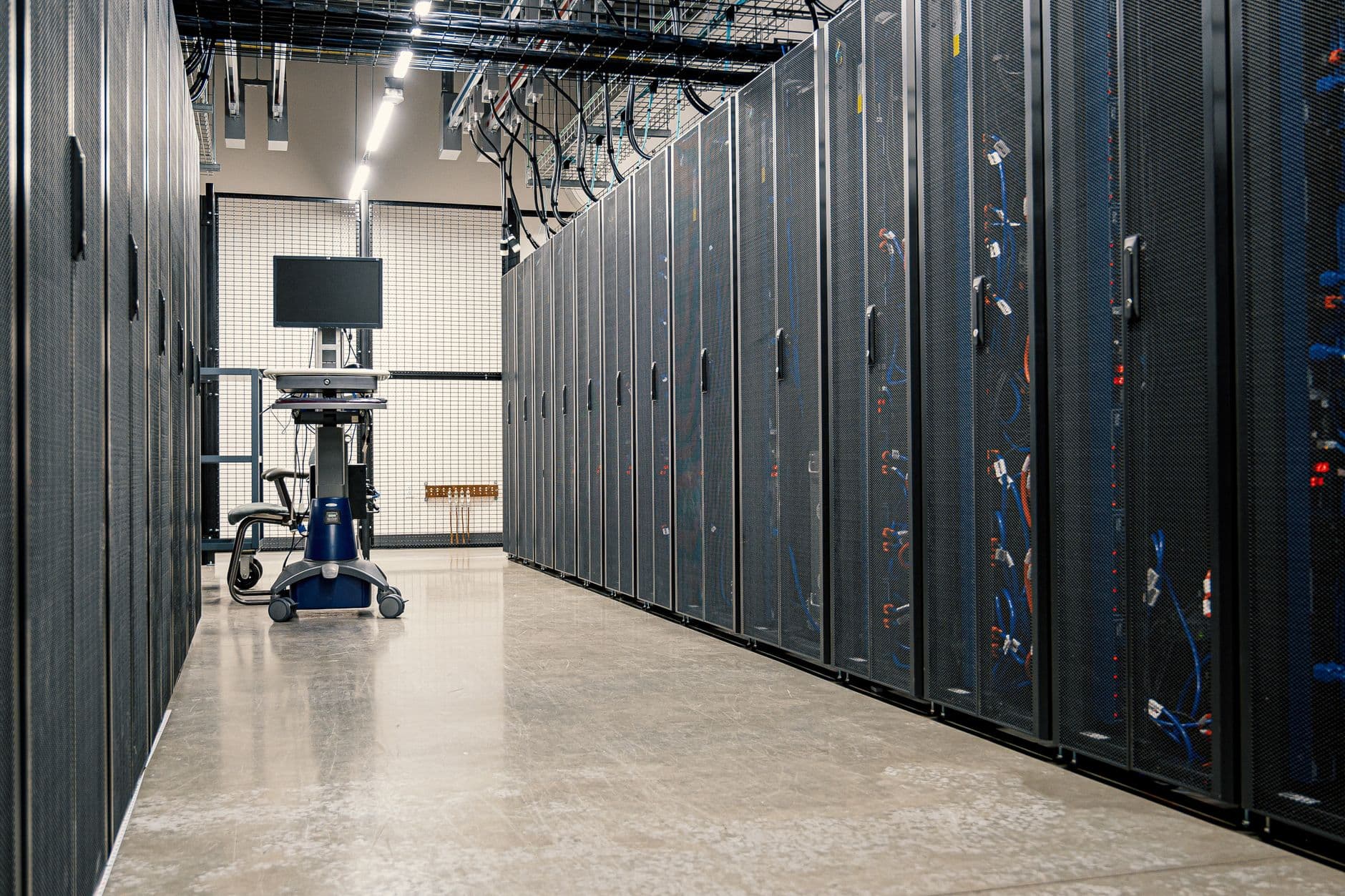
Photo by Brett Sayles on Pexels
Why Data Center Cooling Is the Hardest Case Under Subpart C
Subpart C is sector-agnostic on its face — § 84.104 ties applicability to refrigerant charge size and GWP, not to building use. In practice, though, data centers concentrate every condition that makes compliance difficult: very large per-unit charges, redundant systems that multiply that charge across N+1 or 2N topologies, contractually enforceable uptime targets that make a 30-day repair clock awkward, and a procurement cycle long enough that today's decisions are governed by tomorrow's GWP step-downs.
The cooling load itself is also growing in a way no other commercial sector matches. AI training and inference workloads have pushed rack densities from the traditional 5–10 kW range into 30 kW and beyond, with hyperscale GPU clusters approaching 100 kW per rack. That heat has to go somewhere, and for the existing installed base it goes through DX coils and chiller circuits filled with R-410A, R-134a, and R-407C — all squarely inside the AIM Act phasedown.
What looks like an HVAC question is really three intertwined questions: a compliance question (am I subject to § 84.106 leak management?), a procurement question (which refrigerant survives the next decade of step-downs?), and a thermodynamic question (does the underlying cooling architecture still make sense, or has the phasedown changed the math?).
Regulatory Scope: How § 84.104 and § 84.106 Apply to Data Center HVAC
Subpart C draws its applicability boundary at appliances with a full refrigerant charge of 15 pounds or more containing a regulated substance with a GWP greater than 53. For data center cooling equipment, that boundary captures almost everything in the mechanical plant. A 20-ton CRAC unit charged with R-410A carries roughly 22–28 pounds. A 500-ton water-cooled chiller running R-134a may hold 900–1,400 pounds. A medium-sized colocation site with twenty CRAC units and a pair of redundant chillers can easily sit on top of three to five tons of regulated refrigerant before counting the dry coolers and pumped refrigerant economizers.
Once an appliance is in scope, § 84.106 imposes the full leak management regime: leak rate calculations after every refrigerant addition, repair within 30 days of identifying a threshold exceedance, verification testing, and three-year recordkeeping. The numerical leak rate thresholds — 20% annualized for commercial refrigeration, 30% for industrial process, 10% for comfort cooling — are where data center operators have to pay attention. EPA's sector framing puts data center HVAC under the comfort cooling threshold (10%) for most CRAC, CRAH, and chiller installations, which is the tightest in the rule.
The threshold question matters because data center compressors run continuously at high duty cycle, and gasket and fitting wear scales with operating hours. A leak rate that would be merely annoying in a comfort cooling office building can become a compliance issue much faster in a 24/7 mission-critical environment.
| Equipment Type | Typical Charge | Common Refrigerant | In Scope? |
|---|---|---|---|
| 10–30 ton CRAC (DX) | 15–40 lbs | R-410A (GWP 2,088) | Yes |
| CRAH (chilled water) | No refrigerant on the air handler itself | N/A at the CRAH | Tied to upstream chiller |
| 150–500 ton air-cooled chiller | 200–700 lbs | R-410A / R-454B / R-32 | Yes |
| 500–1,500 ton water-cooled centrifugal chiller | 900–2,500 lbs | R-134a / R-1233zd / R-513A | Yes |
| Pumped refrigerant economizer | 40–200 lbs | R-134a / R-410A | Yes |
| Single-phase liquid cooling (CDU) | Water / glycol (no refrigerant) | N/A | No |
| Two-phase immersion (3M Novec-class, fluoroketones) | Tank-dependent | Dielectric fluids (separately regulated) | Out of Subpart C scope; check PFAS rules |
For operators trying to figure out which of their units cross the 15-pound threshold, see the detailed walkthrough on the § 84.106(a) 15-pound charge threshold.
CRAC vs. CRAH: Where the Refrigerant Risk Actually Sits
The architectural distinction between Computer Room Air Conditioners (CRAC) and Computer Room Air Handlers (CRAH) is decisive for Subpart C exposure. A CRAC unit contains its own compressor and refrigerant circuit — typically R-410A in modern installations, R-407C in older retrofits, and R-22 in the legacy fleet that is now end-of-service. Each CRAC is its own appliance under § 84.106 and must be tracked, leak-rate calculated, and recorded individually.
A CRAH unit, by contrast, is just a fan and a chilled water coil. The refrigerant sits centralized in the chiller plant. From a compliance standpoint this is generally easier: one large appliance with one recordkeeping file replaces twenty or forty CRAC files. From an operational standpoint it concentrates risk — a chiller fault becomes a single point of failure for cooling across the entire floor — which is why most data centers run N+1 or 2N chiller redundancy.
The practical takeaway for facility managers running mixed fleets:
- CRAC-heavy sites face higher administrative load (one record file per unit), more frequent service events at smaller charge sizes, and higher cumulative leak rate exposure because compressor seals on packaged DX units have shorter mean time between failures than centrifugal chiller seals.
- Chilled-water sites consolidate refrigerant into a small number of large appliances. A single leak event has bigger atmospheric and economic consequences, but ongoing recordkeeping is simpler, and the chiller refrigerant lineup (low-GWP HFOs and blends like R-1233zd, R-1234ze, R-513A) gives more long-term optionality than R-410A.
- Hybrid sites — chilled water for the main hall plus CRAC redundancy in network rooms and battery rooms — get the worst of both worlds for compliance overhead and should plan their recordkeeping system around that complexity from day one.
The R-410A Retrofit Decision for CRAC Fleets
R-410A (GWP 2,088) has been the workhorse for packaged DX cooling for two decades. Under the AIM Act phasedown, it is being squeezed from two directions at once: the supply-side allowance reductions that tighten production volumes year over year, and the sector-specific GWP caps that prohibit new R-410A equipment manufacture from January 1, 2025 for most new comfort and computer-room applications. The installed base is not banned — it can continue operating and can be serviced with reclaimed or remaining new R-410A — but the cost curve and the supply curve are both moving the wrong direction.
The retrofit conversation for an existing CRAC fleet generally centers on three options:
1. Run R-410A to end of life with reclaimed supply
For a CRAC fleet that is 8–12 years into a 15-year compressor life, this often pencils out. Reclaimed R-410A continues to be lawful for servicing existing equipment, the unit will be retired before the supply genuinely runs out, and the avoided capital outlay can be redirected to the next architectural change. The cost is rising service charges per pound and increasing exposure to leak rate threshold violations if seals begin to fail.
2. Drop-in to a lower-GWP A2L blend
R-454B (GWP 466) and R-32 (GWP 675) are the two refrigerants the packaged equipment industry has standardized on for the post- R-410A generation. Both are mildly flammable (ASHRAE class A2L) and require code-compliant detection, alarm, and ventilation — which complicates installation inside a computer room with people and electronics. True drop-in retrofit of an existing R-410A CRAC to an A2L refrigerant is generally not supported by manufacturers; the realistic path is replacement at end of compressor life.
3. Architectural change: convert DX rooms to chilled water
For data halls where the cooling architecture is being touched anyway — for example to support a density increase — converting CRAC rooms to CRAH service from a central chiller plant simplifies the long-term refrigerant story. The refrigerant problem moves into a smaller number of large chillers where the low-GWP options (R-1233zd at GWP ≈1, R-1234ze at GWP <1, R-513A at GWP ≈573) are already mature.
The retrofit-or-replace question is the same one supermarket and process refrigeration operators are working through. The detailed framework — including how to value remaining compressor life against rising service costs — is laid out in the retrofit vs. retirement decision guide.
Water-Cooled Chiller Arrays: Where the Big Charges Live
A 1,000-ton water-cooled centrifugal chiller running R-134a holds in the range of 1,200–1,800 pounds of refrigerant. An N+1 array of four such chillers at a single hyperscale data hall sits on roughly three tons of HFC. Under § 84.106 each chiller is an individual appliance with its own leak rate calculation, repair clock, and verification testing obligation. A single seal failure that releases 200 pounds is a 12–17% leak rate event on a 1,200–1,800 pound charge — meaning it either triggers the repair clock immediately on a comfort-cooling threshold reading or sits dangerously close to it.
The chiller refrigerant lineup has moved faster than the packaged equipment side because the OEMs have a clearer commercial path. New centrifugal chillers in 2026 are predominantly offered with one of:
- R-1233zd(E) — HFO with GWP near 1, class A1 (non-flammable). The default for low-pressure centrifugal designs.
- R-1234ze(E) — HFO with GWP <1, class A2L (mildly flammable). Common in newer medium-pressure centrifugal chillers.
- R-513A — HFO/HFC blend with GWP ≈573, class A1. A drop-in retrofit option for some R-134a chillers and a popular choice for operators who want non-flammability and a moderate GWP reduction without architectural change.
- R-1234yf — primarily in smaller positive-pressure machines.
For an existing R-134a chiller fleet, the practical decision is whether to retrofit to R-513A — a manufacturer-supported conversion for many models — or run the existing R-134a charge until the chiller itself is replaced. R-134a (GWP 1,430) is not banned for service, but the allowance trajectory and the EPA Significant New Use rule interactions mean that per-pound cost will continue rising. A retrofit to R-513A typically buys roughly a 60% GWP reduction without a hardware swap, at the cost of a service event, oil compatibility check, and a modest capacity derate.
For background on how the allowance schedule itself is structured — which is what ultimately drives the price curve — see the HFC phasedown step-down schedule.
Free Cooling, Economizer Tradeoffs, and Refrigerant Charge
Free cooling — using outside air, evaporative cooling towers, or pumped refrigerant economizers to displace compressor work — is the single biggest lever data center operators have to reduce PUE. Under the phasedown it also has a second-order compliance effect that is worth thinking through carefully.
Air-side economizers (direct or indirect outside air through the air handlers) don't change refrigerant charge but do reduce compressor runtime, which generally reduces seal wear and leak frequency. They also reduce the consequence of a leak — a partially discharged system can often coast on economizer mode while repair is scheduled, which is operationally significant when the § 84.106 30-day repair clock is running against a contractual SLA.
Water-side economizers (plate-and-frame heat exchangers between the cooling tower loop and the chilled water loop) similarly reduce chiller runtime without adding refrigerant. They're the right answer in climates where wet-bulb temperatures support useful hours of compressor-off operation.
Pumped refrigerant economizers are the awkward case. They're excellent thermodynamically — they extend free-cooling hours into temperature ranges where water-side economizers struggle — but they add a second refrigerant circuit to the system, typically R-410A or R-134a, in the 40–200 pound range. Under § 84.106 that is a separately tracked appliance. The energy savings still pencil out in most cases, but the compliance ledger has another line item, and a leak in the economizer circuit triggers the same repair clock and recordkeeping obligations as a leak in the primary chiller.
Design-stage note: When an economizer adds a second refrigerant circuit, the unit-level leak rate calculation should be reviewed against both the primary and the secondary charge. Operators sometimes treat the economizer as a subsystem of the primary appliance for recordkeeping purposes — that is not how EPA reads § 84.106. Each circuit with its own compressor and its own seal points is its own appliance.
For more on the leak rate math itself, see the § 84.106(b) leak rate calculation methods.
Liquid Cooling Adoption Pressure: Direct-to-Chip and Immersion
The AI-driven jump in rack density is forcing a reconsideration of whether air-based cooling — and by extension, the entire refrigerant stack that supports it — is the right architecture for the next generation of build. At 30 kW per rack, air cooling is still feasible with hot aisle containment and elevated supply temperatures. At 50–100+ kW per rack, it stops being feasible at any reasonable airflow, and direct-to-chip or immersion liquid cooling becomes the dominant heat removal path.
From a Subpart C perspective, this matters because direct-to-chip cooling with single-phase fluids (water with corrosion inhibitor, glycol blends) is outside Subpart C — there is no regulated refrigerant in the loop. Heat is rejected through a coolant distribution unit (CDU) into the building chilled water loop, which may still be served by an R-134a or R-513A chiller, but the per-rack heat is moving as water rather than air. The chiller plant becomes smaller per kW of IT load, and the CRAC/CRAH fleet either shrinks or disappears.
Immersion cooling is more nuanced. Single-phase immersion in mineral oil or synthetic hydrocarbon is, like direct-to-chip, refrigerant- free. Two-phase immersion has historically used fluoroketones (3M Novec-class fluids) which sit in a different regulatory bucket: generally not covered by 40 CFR Part 84 — these fluids are not refrigerants in the AIM Act sense — but increasingly affected by PFAS-related regulatory pressure and by 3M's announced exit from PFAS manufacturing by end of 2025. Operators evaluating two- phase immersion in 2026 are buying into a fluid market with real supply uncertainty even though it sits outside Subpart C.
For most hyperscale operators, the practical pattern emerging in 2026 is direct-to-chip for the GPU clusters paired with shrunken air cooling for the remaining infrastructure — which lets the chiller plant get smaller and the refrigerant compliance footprint shrink as a side effect of the density transition.
Allowance Economics and the Hyperscale Buildout
The AIM Act allocates HFC consumption allowances by entity, with the total pool stepping down on a published schedule toward an 85% reduction from baseline by 2036. The published 2026 allocations continue the step-down trajectory established in earlier years; EPA publishes the entity-level allocations annually in the Federal Register. None of this allowance pool is specifically reserved for data center cooling — it competes with automotive air conditioning, commercial refrigeration, foam blowing, aerosols, and fire suppression for the same shrinking supply.
The collision of this shrinking pool with the simultaneous hyperscale buildout is the central economic story for data center HVAC over the next five years. Industry-published forecasts put U.S. data center load growth at compound rates that imply doubling of cooling capacity installed within a decade. If the marginal new megawatt of cooling load is being served by R-410A or R-134a equipment drawing from a contracting allowance pool, the per-pound refrigerant price rises in a way that progressively penalizes high-GWP choices and rewards architectures that minimize charge per kW of cooling.
A few practical implications for capital planning:
- Total cost of ownership models should price in rising refrigerant costs over the equipment's useful life, not just current spot pricing. A 1,500-pound R-134a chiller charge in 2026 might cost roughly the same as it did in 2024; the same charge in 2032, after two more allowance step-downs, will not.
- Vendor selection for new chillers should favor refrigerant futures that have demonstrated supply mechanisms (HFOs produced domestically) over those that depend entirely on the contracting AIM Act allowance pool.
- Procurement teams should treat refrigerant as a commodity exposure, not as a service line item. Hedging through reclaim agreements with EPA-certified reclaimers and multi-year supply contracts is becoming standard practice for larger operators.
For more on how the allowance pool and step-down schedule work, including the published annual allocations, see the AIM Act overview and allowance structure.
Leak Management When the Equipment Cannot Be Taken Offline
The § 84.106 repair clock — 30 days from identification of a threshold-exceeding leak — assumes the equipment can be brought offline for repair. In a data center, that assumption frequently does not hold. A chiller in an N+1 array can be taken down for service if the remaining chillers can carry the load, but during peak summer conditions or in the middle of an AI training run, the operational tolerance evaporates. A CRAC in a network closet protecting a single critical asset may have no redundant capacity at all.
Subpart C does provide for industrial process and seasonal extensions to the 30-day repair window where defined criteria are met, but those extensions require documented justification, EPA notification in some cases, and a written repair plan. Data center cooling does not fit neatly into the "industrial process" category as EPA originally framed it — the rule was written with food processing and chemical manufacturing in mind, where shutdown requires synchronization with batch cycles. Whether a mission- critical IT operation qualifies for an analogous extension is one of the genuinely ambiguous areas of the rule for the data center sector. Practical compliance counsel typically advises documenting the operational constraint thoroughly, communicating with the EPA regional office before relying on an extension, and treating the extension as a backstop rather than a planning assumption.
The defensive posture is to invest in three things:
- Continuous leak detection. § 84.108 imposes automatic leak detection requirements on large commercial refrigeration; data center chillers are not directly captured by that mandate, but the same technology — continuous refrigerant sensors in the chiller room, with alarm integration into the BMS — substantially shortens the time between leak onset and identification, which is what the repair clock measures from. For more on the technology, see the § 84.108 automatic leak detection guide.
- Redundancy that supports compliance. N+1 chiller design is not just an uptime story; it is what gives the operator the ability to take a leaking chiller offline within the repair window without breaking an SLA. Capital plans that erode redundancy also erode compliance flexibility.
- Pre-staged repair capability. Major OEM service contracts with guaranteed parts availability and 24-hour technician dispatch are the difference between a 5-day repair and a 35-day repair. The marginal contract cost is small relative to the penalty exposure on a missed repair window.
Recordkeeping at Hyperscale: Beyond Spreadsheets
§ 84.106(l) requires three-year retention of equipment baseline data, service events, leak rate calculations, repair records, and verification testing for every appliance in scope. A single hyperscale campus can easily have 200+ appliances in scope when CRAC fleets, chillers, and economizer circuits are all counted. A regional operator running ten such campuses is looking at thousands of individual appliance records, each with its own service history spanning multiple technicians, contractors, and refrigerant lots.
Spreadsheet-based recordkeeping does not scale to this — not because spreadsheets are technically incapable of holding the data, but because the workflow around capturing service-event data from contractor invoices, performing leak rate calculations within the required windows, and producing audit-ready records on demand becomes unmanageable. The failure modes look like missing CoAs on refrigerant additions, leak rate calculations performed inconsistently across sites, and an inability to produce a clean equipment-level history when an EPA Information Request Letter arrives.
Tooling note: Multi-site operators tracking CRAC/CRAH/chiller fleets across multiple campuses generally need a purpose-built compliance system rather than a spreadsheet. RefriTrak™ is one of the platforms used in this space — it links each appliance to its baseline data, service events, leak rate calculations, and three-year retention requirement, and produces the equipment-level audit packets EPA typically requests during a facility inspection. The point of recommending purpose-built software here is not branding; it is that the volume of records in a hyperscale environment exceeds what manual processes reliably handle.
For a deeper treatment of recordkeeping requirements applicable to data center fleets, see the § 84.106(l) recordkeeping requirements guide.
A Strategic Playbook: Three Horizons
The right answer for any specific facility depends on its existing architecture, capital cycle, and growth trajectory. A useful frame is to separate decisions into three horizons:
Horizon 1 (0–18 months): Compliance hygiene
Complete the appliance inventory across all sites; confirm full charge documentation for every unit; establish leak rate calculation workflow tied to every service event; verify recordkeeping system can produce equipment-level audit packets; audit refrigerant supplier chain to confirm allowance-holder status. This is foundation work that does not depend on any architectural decision and reduces enforcement exposure immediately.
Horizon 2 (18 months–5 years): Targeted retrofits and chiller transitions
For existing R-134a chiller fleets, evaluate R-513A retrofit at next scheduled service window. For end-of-life R-410A CRACs, replace with A2L-compatible new equipment matched to current load profile rather than direct one-for-one swap (which often results in oversized equipment). Add continuous leak detection in chiller rooms even where not strictly mandated.
Horizon 3 (5–10 years): Architectural transitions
For high-density growth, design new build for direct-to-chip liquid cooling on the GPU clusters and chilled water (HFO-based chillers) for the remainder. For existing facilities with viable compressor life remaining, plan the next major capital cycle around a refrigerant lineup that survives the 2032 and 2036 step-downs. The goal at this horizon is to ensure no facility ends up stranded with high-GWP equipment that cannot be economically serviced.
Common Pitfalls in Data Center Refrigerant Strategy
- Treating R-410A as a stable platform. It is no longer one. New equipment manufacture restrictions are already in effect for most computer-room applications; the service supply curve is going one direction only. Capital plans built on indefinite R-410A availability are exposed.
- Underestimating chiller charge. A 1,000-ton centrifugal chiller is closer to 1,500 pounds of refrigerant than the 200–300 pounds operators sometimes assume from familiarity with packaged equipment. The compliance and economic stakes scale with that charge.
- Counting pumped refrigerant economizers as part of the primary appliance. They are not; they have their own compressor and their own charge, and they get their own line in the recordkeeping system.
- Assuming "industrial process" extensions cover data centers. The rule was not written with mission- critical IT in mind. Any reliance on extensions should be documented in advance and discussed with the regional office.
- Buying refrigerant on price alone. Below-market offers from unfamiliar suppliers are the entry point for illegally imported HFCs into the data center supply chain. See the dedicated guidance on counterfeit refrigerants and procurement due diligence.
Frequently Asked Questions
Does Subpart C apply differently to data centers than to commercial office HVAC?
Not as a separate sector. § 84.104 applicability is driven by refrigerant charge size (≥15 lbs) and GWP (>53), not by building use. The leak rate threshold that applies — 10% for comfort cooling — generally captures the CRAC, CRAH, and chiller equipment that serves a data center. What is different is the operational context: continuous duty cycle, larger per-unit charges, and lower tolerance for taking equipment offline during the 30-day repair window. The rule is the same; the implementation difficulty is materially higher.
Can I keep operating R-410A CRAC units indefinitely?
You can operate and service existing R-410A equipment lawfully — the equipment is not banned, only new manufacture for most applications is restricted. The practical limit is supply: as the AIM Act allowance pool contracts, R-410A becomes more expensive and harder to source, and reclaimed product becomes the dominant supply channel. Most operators are now planning to run existing R-410A fleets to compressor end-of-life rather than early retrofit, but stocking expectations and service contracts need to reflect rising costs.
Is R-513A a true drop-in for R-134a chillers?
For many R-134a centrifugal chiller models, manufacturers support R-513A as a retrofit refrigerant — but it is not a gas-only swap. The retrofit typically requires an oil compatibility assessment (POE oil compatibility is usually fine but should be verified), a flush of the system, and recalibration of controls. There is a modest capacity derate (commonly 2–5%) and a modest efficiency impact. Always confirm with the chiller OEM for the specific model before treating R-513A as a drop-in.
Does direct-to-chip liquid cooling eliminate refrigerant compliance obligations?
It eliminates them at the rack level — single-phase water or glycol carries the heat from the chip to the CDU, and that loop is not a regulated refrigerant. But the CDU rejects heat into the building chilled water loop, which in most facilities is still served by a refrigerant-based chiller. Direct-to-chip shrinks the refrigerant footprint significantly (the chiller plant gets smaller per kW of IT load), but it does not eliminate it.
How do I handle the 30-day repair clock when I cannot take a chiller offline?
The defensible approach is to design redundancy that lets you take a chiller offline within the window (N+1 or 2N), stage service contracts with guaranteed parts availability so the repair itself takes hours rather than weeks, and document every operational constraint thoroughly if you do need to rely on an extension. The rule does provide for extensions when the equipment cannot reasonably be repaired within 30 days, but the criteria are not specifically tailored to mission-critical IT and EPA notification may be required depending on the facts. Engage compliance counsel before relying on an extension; do not treat it as part of standard planning.
Should hyperscale operators self-perform refrigerant compliance or contract it out?
At hyperscale, the answer is usually a hybrid: a small internal compliance team owning the policy, recordkeeping system, supplier qualification, and EPA-facing communications, with service execution contracted to OEM-authorized providers who hold Section 608 certification and integrate with the internal recordkeeping platform. The owner/operator legal responsibility for records under § 84.106(l) cannot be contractually transferred to a service provider, so even fully outsourced service models still require the owner to maintain the system of record.
How should I think about refrigerant in a new build design?
Design for the refrigerant you will be servicing in 2036, not 2026. That means HFO-based chiller refrigerants (R-1233zd, R-1234ze, R-513A) for chilled water plants; A2L compatibility for any DX equipment that will see new manufacture; minimized total charge per kW of cooling delivered; and a clear capacity path for retrofitting toward direct-to-chip liquid cooling on high-density halls. Building today around R-410A or R-134a is accepting a known regulatory and economic decay curve.
Related Resources
R-410A Replacement Guide →
The full picture on R-410A successors — R-454B, R-32, R-513A — with retrofit and replacement decision criteria.
HFC Phasedown Schedule →
The published step-down trajectory through 2036 — what allowance contraction means for refrigerant pricing.
§ 84.108 Automatic Leak Detection →
How continuous detection technology shortens the time from leak onset to identification — and why data center operators are adopting it even where not mandated.
§ 84.106(l) Recordkeeping Requirements →
The full recordkeeping framework — what to capture, how long to retain it, and how to organize records for an EPA inspection.
EPA Audit Preparation →
What an EPA Information Request Letter or facility inspection looks like in practice, and how to be ready for it.
Counterfeit Refrigerants Risk →
Procurement due diligence for refrigerant purchasing — red flags, supplier verification, and the rising risk of illegally imported HFCs entering data center supply chains.
Sources
- eCFR — 40 CFR Part 84 Subpart C (Management of Regulated Substances)
- eCFR — 40 CFR § 84.104 Applicability
- eCFR — 40 CFR § 84.106 Leak Repair Requirements
- EPA — HFC Phasedown and the AIM Act
- EPA — Technology Transitions Under the AIM Act
- EPA — HFC Allowances
- Federal Register — Notice of 2026 Allowance Allocations (Nov. 20, 2025)
- U.S. Department of Energy — Data Centers and Servers
- ASHRAE — Datacom Series (data center thermal guidelines)