Supermarket Refrigeration Compliance Under the AIM Act
Supermarkets operate the largest and most refrigerant-intensive installations regulated under 40 CFR Part 84 Subpart C. A single store can hold a charge of well over a thousand pounds across a multi-rack system, and many chains operate hundreds of such stores. That scale puts the sector squarely in EPA's enforcement crosshairs and turns every leak event into a measurable compliance, financial, and reputational risk. This guide walks facility managers and compliance officers through the specific Subpart C obligations that apply to supermarkets, the alternatives reshaping the architecture of new stores, and the operational program needed to stay ahead of an inspection.
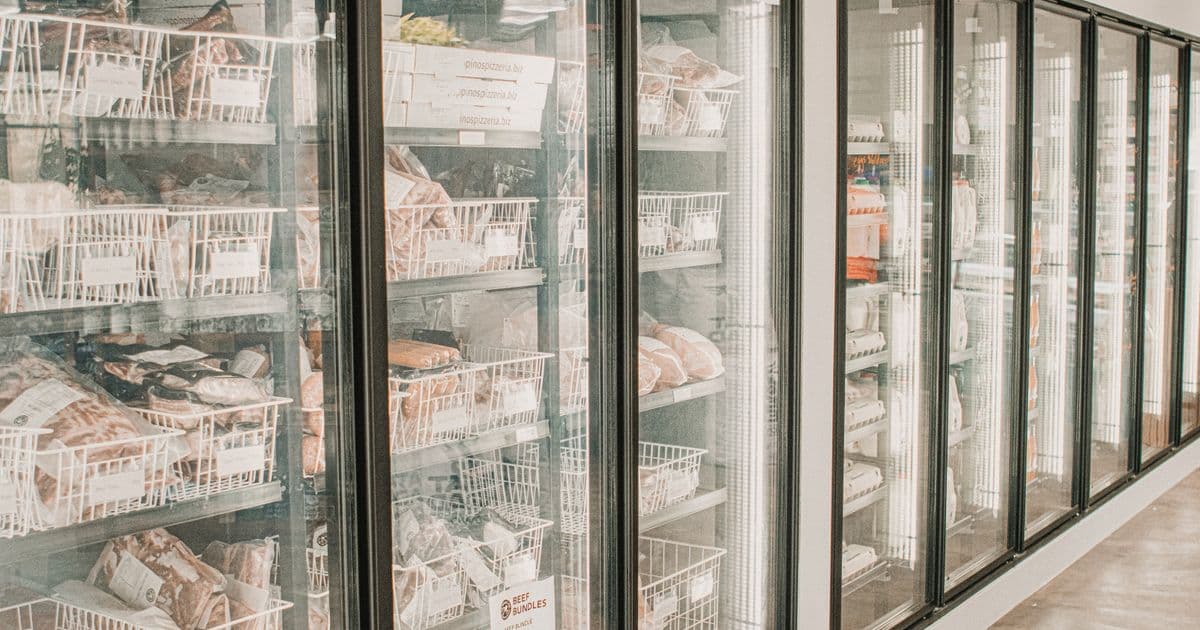
Photo by Daniel & Hannah Snipes on Pexels
Why Supermarkets Are an EPA Enforcement Focus
The supermarket sector has been a focus of federal refrigerant enforcement for more than two decades. Under EPA's now-superseded GreenChill program, voluntary participants reported average store charges between roughly 2,500 and 4,500 pounds and an industry-average leak rate near 25 percent annually. That figure is consistently cited in EPA's rulemaking docket as justification for the leak repair and automatic leak detection (ALD) requirements now codified in Subpart C. Even after years of voluntary improvement, a typical supermarket leaks an order of magnitude more refrigerant per year than nearly any other commercial application of comparable footprint.
That emissions profile makes the sector a natural target. Each pound of R-404A vented to atmosphere carries a global warming potential of approximately 3,922 CO2-equivalent — meaning a single store losing 1,000 pounds in a year produces nearly 4,000 metric tons of CO2-equivalent emissions. Across a chain of several hundred stores, that scale moves the needle at a national level and attracts agency attention.
EPA has pursued enforcement actions in this sector through both the AIM Act and the predecessor Section 608 framework. The agency's own enforcement bulletins identify large food retail as a category where it expects to maintain active compliance oversight as Subpart C takes effect, citing the combination of high charge size, distributed system architecture, and historical leak performance.
Bottom line: Compliance in this sector is not a theoretical exercise. The combination of large charge size, large store counts, and a well-documented historical leak rate makes supermarket operators among the highest-risk regulated entities under Subpart C — and among the easiest for EPA to identify and audit.
Which Subpart C Provisions Apply to Supermarkets
Three sections of 40 CFR Part 84 Subpart C carry most of the operational burden for supermarkets:
| Section | What It Requires | Supermarket Application |
|---|---|---|
| § 84.102 (Definitions) | Defines "appliance," "commercial refrigeration," "full charge," and other threshold-triggering terms. | Each rack typically qualifies as a separate appliance with its own full-charge calculation; case-level connections do not reset the charge boundary. |
| § 84.106 (Leak repair) | Establishes the 20% commercial refrigeration leak rate threshold, 30-day repair window, verification testing, and retrofit/retirement obligations. | Virtually every large rack system in a supermarket falls within the applicability threshold and is subject to the full leak repair regime. |
| § 84.108 (Automatic leak detection) | Requires continuous ALD on appliances meeting the equipment type, charge size, and GWP thresholds. | Any commercial refrigeration appliance with a full charge of 1,500 pounds or more containing a high-GWP refrigerant is in scope — the typical supermarket rack. |
Beyond those three, the recordkeeping rules in § 84.106(l) impose a three-year retention obligation on the documentation generated by all of these activities. For a multi-store operator, that is a substantial volume of records across many appliances, many service events, and many leak inspections.
Where Subpart C is ambiguous — for example, whether the connection of a satellite low-temperature rack through shared piping converts two racks into a single appliance for charge-size purposes — the conservative reading treats them as a single appliance because that interpretation triggers the broadest compliance obligations. EPA has not issued definitive subregulatory guidance on this point. Owners should document their boundary determination, the basis for it, and flag it in the compliance file in case the question arises during an inspection.
Anatomy of a Typical Supermarket Refrigeration System
The compliance picture for supermarkets is shaped by an architecture that no other commercial application replicates. Understanding the layout is necessary to apply the rules sensibly.
A traditional U.S. supermarket runs direct expansion (DX) multiplex rack refrigeration. Compressors are clustered on two or three racks in a back-of-house machinery room: a medium-temperature rack serving deli, produce, dairy, and meat cases; a low-temperature rack serving frozen food and ice cream cases; and, in some configurations, a separate parallel rack for the meat department or seafood. Each rack typically holds between four and eight reciprocating or scroll compressors operating in parallel under a shared suction and discharge manifold.
From the machinery room, copper or steel refrigerant piping radiates across the entire sales floor to the display cases and walk-ins. A single store can carry several thousand linear feet of piping with dozens of joints, valves, and flares. The condenser bank sits outside on the roof or in a fenced enclosure at grade. The charge is accordingly distributed: thousands of pounds of refrigerant are not sitting in one tank, they are spread across hundreds of feet of pipe, many cases, and many joints, every one of which is a potential leak source.
Typical Charge Sizes by Store Format
- Small format (convenience / urban): 200–800 pounds across one or two small racks. Often below the § 84.108 ALD threshold but still well within § 84.106 applicability.
- Standard supermarket (40,000–60,000 sq ft): 1,500–3,500 pounds across two to three racks. Squarely in scope for ALD on most refrigerants, with both medium- and low-temperature systems individually crossing the 1,500-pound floor.
- Large format / hypermarket (60,000+ sq ft): 3,500–6,000+ pounds across multiple parallel racks. Multiple appliances each subject to ALD; the full compliance regime applies at the appliance level.
- Distribution center / cold storage warehouse: 10,000–50,000+ pounds. Sometimes overlaps with industrial process refrigeration definitions; ALD is universally applicable and ammonia or transcritical CO2 are increasingly chosen at this scale.
The architecture matters because Subpart C's thresholds attach at the appliance level, not the facility level. A store with three racks that each individually hold less than 1,500 pounds may not trigger § 84.108, even if the facility total is 3,000 pounds. Conversely, a medium-temperature rack at 1,800 pounds is in scope on its own, even if it sits next to a 600-pound low-temperature rack that is not. The appliance-by-appliance analysis is the first step in any compliance audit.
ALD Obligations on Supermarket Racks
Section 84.108 applies to commercial refrigeration appliances with a full charge of 1,500 pounds or more containing a regulated substance or substitute with a GWP greater than 53. For most supermarket racks using R-404A (GWP ~3,922), R-407A (GWP ~2,107), R-448A (GWP ~1,387), or R-449A (GWP ~1,397), the only relevant filter is charge size. Refrigerants with GWP at or below 53 — propane (R-290), ammonia (R-717), and CO2 (R-744) — fall outside the ALD scope by definition.
For more detail on the technical requirements, sensor selection, and alarm thresholds, see the dedicated § 84.108 ALD compliance guide. The supermarket-specific considerations are these:
- Indoor coverage is mandatory; outdoor is exempt. Under § 84.108(e), the rule applies to components inside an enclosed building or structure. Sales-floor cases, walk-ins, and the machinery room itself are in scope. Rooftop condensers and outdoor remote condensing units are not subject to ALD — but unmonitored portions still require periodic manual leak inspection under § 84.106(g).
- Sensor density follows the architecture. A typical supermarket installation requires sensors in the machinery room, in each walk-in, and at appropriate intervals across the sales floor where case piping concentrates. Single-sensor installations are almost never compliant for stores carrying 1,500-plus pound charges.
- 10 ppm detection / 100 ppm alarm thresholds drive technology choice. The detection floor effectively requires NDIR (non-dispersive infrared) sensors. Lower-cost MOS (metal oxide semiconductor) sensors generally cannot meet the 10 ppm specification and are not viable for § 84.108(f) compliance.
- The condition-monitoring alternative is rarely the right choice. Section 84.108(g) allows monitoring of appliance operating parameters with an alert threshold at 50 pounds or 10% of full charge, whichever is less. On a 2,000-pound rack, that means a 50-pound trigger — a substantial venting event by the time it alarms. Direct refrigerant detection catches leaks well before that threshold and is the dominant approach in modern installations.
- The compliance benefit: replaces quarterly inspections. Section 84.106(g)(4) waives periodic manual leak inspections on portions of an appliance that are continuously monitored by an ALD system audited or calibrated annually. For a large store with hundreds of case fittings, this is a meaningful operational savings — and one of the strongest economic arguments for installing ALD even where the rule does not strictly require it.
Common pitfall: Installing ALD on indoor portions of the system and then assuming the entire appliance is exempt from manual inspection. Outdoor condensers, rooftop refrigerant piping, and any portion not actually monitored by ALD remain subject to § 84.106(g) periodic inspection. The records must clearly identify which portions are ALD-covered and which are not.
Leak Repair on Distributed Multi-Rack Systems
Section 84.106 sets a 20% leak rate threshold for commercial refrigeration appliances (compared with 30% for industrial process refrigeration and 10% for comfort cooling). Once an appliance's calculated leak rate crosses 20% in any 12-month window, the owner has 30 days to repair the leak (60 days if a retrofit or retirement plan is invoked) and conduct verification testing.
On a 2,000-pound supermarket rack, the 20% threshold equates to 400 pounds of refrigerant lost in a rolling 12-month window. That is not a difficult threshold to hit. The 2017 industry-average leak rate was north of 25% — meaning the median supermarket rack would historically have been over threshold and in active repair obligation every year. The compliance pressure created by § 84.106 is precisely what drove investment in better service practices, more frequent leak inspection, and ALD adoption ahead of the 2026 effective date.
For multi-rack stores, calculation must be done per appliance, not per facility. A 30% rate on the low-temperature rack does not get diluted by a 5% rate on the medium-temperature rack. Each is calculated and tracked independently. See the leak rate calculation methods guide for the annualized and rolling-average approaches.
Verification testing on a sales-floor system
The verification testing requirement after a leak repair — typically an initial verification test and a follow-up test within 30 days at operating conditions — is operationally meaningful in a supermarket. Bringing down a rack to perform a standing pressure or vacuum test interrupts service to the connected cases. Many operators schedule repairs and tests during overnight or low-traffic hours, with temporary product moves to functional cases, to avoid spoilage. The repair window does not pause for the operator's convenience.
Where repair is not feasible — for example, on aged DX systems where identifying the leak source proves impractical — the retrofit/retirement path under § 84.106 becomes the only remaining option. See the retrofit vs. retirement decision guide for the cost and compliance trade-offs at this fork.
Refrigerant Choices: HFC Transition and Alternatives
The AIM Act's HFC phasedown and EPA's Technology Transitions rule are reshaping refrigerant selection for new supermarket installations. Several rule provisions and a growing operational case drive owners toward lower-GWP alternatives.
Legacy HFCs being phased down
R-404A, with a GWP of approximately 3,922, has been the historical workhorse of supermarket low-temperature racks. Its high GWP and consequent allowance cost have made it economically unattractive for new installations. R-407A and R-407F were intermediate replacements but carry GWPs around 2,000 and remain subject to phasedown pressure. R-448A and R-449A — both around 1,400 GWP — are the dominant retrofit and new-install HFC blends today and meet most existing Technology Transitions limits for commercial refrigeration through the near term.
Lower-GWP HFO blends
HFO-containing blends such as R-454C (GWP ~146) and R-455A (GWP ~146) are A2L (mildly flammable) Class 1 refrigerants. They require specific equipment design considerations under ASHRAE Standard 15 and UL 60335-2-89 but are increasingly available in new self-contained and remote-condensing-unit supermarket equipment.
Transcritical CO2 (R-744)
Transcritical CO2 systems have become the dominant architectural choice for new full-line supermarket builds in the United States, following a transition that started in Europe roughly a decade earlier. CO2 has a GWP of 1, falls below the § 84.108(a) GWP threshold of 53, and is therefore exempt from ALD under that section (though jurisdictional safety-code detection requirements still apply, given CO2's asphyxiation risk at elevated concentrations). The system architecture is fundamentally different from DX multiplex rack:
- Operates above CO2's critical point on the high-pressure side (typically 90–120 bar / 1,300–1,750 psi), requiring purpose-built compressors, heat exchangers, and piping rated for these pressures.
- Uses a parallel-compression or ejector-assisted booster configuration to maintain efficiency in warm climates, where transcritical operation is otherwise penalized.
- Carries dramatically less refrigerant mass per ton of capacity because of CO2's high volumetric capacity — total charges of 600–1,200 pounds are common where a comparable HFC system would carry 2,500–3,500 pounds.
- Eliminates AIM Act allowance exposure for the working fluid and removes the operational risk of an HFC supply disruption affecting servicing.
The trade-off is capital cost (transcritical systems remain 15–30% more expensive to install than equivalent HFC rack systems) and a requirement for service technicians trained on the higher operating pressures. The operating-cost picture is increasingly favorable: in warm climates, parallel-compression and ejector designs have closed most of the historical efficiency gap, and in temperate and northern U.S. climates transcritical CO2 can match or beat HFC systems on annual energy.
Distributed propane (R-290) systems
The second major architectural shift is toward small-charge self-contained or distributed propane (R-290) systems, where individual cases or small groups of cases have local compressors and condensers using small propane charges (typically under 150 grams per circuit). The Subpart C applicability picture is fundamentally different here: each self-contained unit is a separate appliance, and the per-circuit charge is well below the 15-pound applicability floor for the leak repair rules. This architecture sidesteps most of Subpart C, although it carries its own electrical and safety considerations under UL 60335-2-89 and local code.
Strategic point: The economic case for transcritical CO2 or distributed propane in new construction is no longer primarily about refrigerant pricing — it is about avoiding the ALD obligation, the ongoing leak repair regime, and the allowance exposure tied to high-GWP HFCs. Compliance costs are now a material line item in any refrigeration capital decision.
Building the Operational Compliance Program
The Subpart C obligations on a multi-store supermarket operator are not satisfiable through ad-hoc spreadsheets and paper service tickets. A compliant program at this scale requires structured equipment inventory, automatic data capture, and audit-ready reporting.
1. Equipment inventory at the appliance level
Catalogue each rack (and each independent satellite system) with its full charge, refrigerant type, install date, and equipment location. The inventory is the foundation of every other compliance activity — without it, leak rate calculation, appliance-level tracking, and ALD applicability all break down.
2. Service record capture per event
Every refrigerant addition and recovery event must be captured against the appliance it served, with date, technician, quantity, and reason. Invoice-based capture from refrigeration contractors is the most reliable source — the technician already records the data for billing purposes, and ingesting it into the compliance system reduces duplicate effort.
3. Automated leak rate calculation
Leak rates should recompute on a rolling basis as new service events come in, with automatic flagging of any appliance crossing the 20% threshold. Manual quarterly recomputation creates unacceptable lag between exceedance and compliance response — by the time the spreadsheet update happens, the 30-day repair clock may already be running. The free leak rate calculator works for one-off checks; portfolio-wide tracking requires integrated software.
4. ALD integration and calibration tracking
The annual ALD audit and calibration required under § 84.108(d) must be scheduled, documented, and retained. A missed calibration window does not just create a § 84.108 violation — it strips the inspection-reduction benefit under § 84.106(g)(4) and reopens manual inspection obligations the operator may not be currently meeting.
5. Three-year record retention with audit-ready export
All records — inventory, service events, leak rate calculations, repair documentation, verification tests, ALD audits — must be retained for three years per § 84.106(l). The records must be producible on EPA request, which in practice means searchable by store, by appliance, by date, and by event type. Paper or site-by-site spreadsheet retention does not survive a serious audit.
For multi-store operators, dedicated refrigerant compliance software substantially reduces the per-store overhead of running this program. Platforms such as RefriTrak™ ingest contractor service invoices, automate leak rate calculations at the appliance level, track ALD calibration windows, and produce audit-ready reports covering the three-year retention period. For a chain managing hundreds of racks across dozens of stores, automation is no longer an optimization — it is what makes compliance feasible.
Preparing for an EPA Inspection
EPA inspections in the supermarket sector typically focus on a predictable set of questions. Compliance officers should be able to produce — within hours, not weeks — the following at the appliance level:
- Full equipment inventory including charge size, refrigerant type, and installation date for every rack and significant satellite system.
- All service records for the past three years showing refrigerant additions and recoveries by appliance and date.
- Leak rate calculations for each appliance, including the methodology used and any threshold exceedances.
- Repair documentation for any exceedance event, including dated initial verification tests and follow-up verification tests.
- ALD installation records, annual audit and calibration certificates, and alarm logs.
- Documentation of which appliance portions are ALD-monitored and which remain on a manual inspection schedule, with corresponding inspection records for the latter.
- Refrigerant procurement records — particularly important after Subpart C's cross-reference to § 82.164 reclamation requirements. See the counterfeit refrigerant compliance guide for supplier verification expectations.
For broader inspection-readiness guidance applicable to any Subpart C regulated entity, see the EPA audit preparation reference. Where penalty exposure is uncertain, the EPA penalty amounts guide covers current civil penalty caps and how violations are counted.
Common Compliance Failures in the Sector
The same patterns recur in supermarket compliance gaps. Recognizing them in advance lets operators pre-empt the issues before they become findings.
- Treating the facility as a single appliance. Subpart C calculations attach at the appliance level. Lumping a low-temp rack's losses into a facility-wide total masks individual exceedances and is not a defensible methodology.
- Missing the satellite rack. Satellite racks for seafood or meat departments are sometimes overlooked in the inventory. They are still appliances under § 84.102 and are still subject to leak repair and (where they meet the threshold) ALD obligations.
- Relying on the contractor for compliance. The owner's obligations under § 84.106 and § 84.108 are not transferred by a service contract. The contractor may perform inspections and repairs, but the owner is the regulated entity and bears the recordkeeping and exceedance-response obligations.
- Letting ALD calibration lapse. Annual audit and calibration is mandatory; missing the window strips the inspection reduction benefit and triggers a § 84.108 violation. Calendar this obligation and document each cycle.
- Spreadsheet drift across stores. Per-store spreadsheets maintained by store-level facility managers diverge in field names, units, and methodology. By the time an audit request hits, harmonizing the data is a week of work — and gaps in historical data are not curable in retrospect.
- No documentation of appliance-boundary decisions. When two racks are shared on a common piping section, the owner's position on whether they constitute one or two appliances should be documented and consistent. Inconsistency across stores is a red flag in an audit.
Looking Forward: Compliance and Capital Planning
The combination of HFC allowance contraction, Technology Transitions GWP limits on new equipment, and the operating burden of Subpart C compliance has reframed refrigeration capital planning at the supermarket level. New stores are being designed around transcritical CO2 or distributed propane not solely for environmental positioning but because the lifecycle cost of an HFC rack — including allowance cost, leak repair obligations, and ALD installation and maintenance — has converged with low-GWP alternatives that carry none of that overhead.
For existing fleets, the question is whether to invest in ALD and intensified leak management on existing HFC racks or to accelerate retrofit/retirement timelines. The math depends on store-specific factors: remaining useful life, historical leak rate, store size, and local climate. Operators with multi-year leak rates persistently above 20% are increasingly accepting the retrofit/retirement cost rather than running an indefinite repair regime.
For broader context on the regulatory trajectory, see the HFC phasedown schedule and the AIM Act overview. The supermarket sector is among the most exposed verticals under this regulatory architecture, and the operators who treat compliance as a structural design problem — not a quarterly reporting exercise — are the ones positioned to manage cost and risk through the phasedown.
Frequently Asked Questions
Does every supermarket rack need automatic leak detection?
Only racks meeting all three § 84.108(a) criteria: commercial or industrial process refrigeration, a full charge of 1,500 pounds or more, and containing a regulated substance or substitute with GWP greater than 53. A 1,200-pound rack falls below the charge threshold. A transcritical CO2 system at any charge size falls below the GWP threshold. A 2,000-pound R-448A rack is squarely in scope.
How is the leak rate calculated when service records are imperfect?
EPA expects the owner to use the best available data. Missing records do not excuse the calculation obligation — they create presumptive non-compliance. Operators should reconstruct service history from contractor invoices, refrigerant purchase records, and on-site logs to the extent possible, and document the methodology used. Going forward, automated capture of service events is the only sustainable approach.
Are transcritical CO2 systems exempt from Subpart C entirely?
CO2 (R-744) has a GWP of 1, far below the § 84.108 threshold of 53 and outside the regulated substance scope, so it is exempt from ALD under that section and from most of the leak repair obligations targeting high-GWP refrigerants. However, jurisdictional safety codes still require CO2 detection due to asphyxiation risk, and ASHRAE Standard 15 imposes machinery room ventilation and alarm requirements independent of EPA. Federal § 84.108 obligations do not apply; other safety and code obligations do.
Can a store-level facility manager handle compliance alone?
For a single-store independent operator, yes — provided the records are kept consistently and the leak rate is recomputed when each service event is logged. For multi-store chains, compliance is an enterprise function. Each store generates service records; the leak rate calculation, ALD oversight, and audit preparation are corporate responsibilities that require consolidated tooling.
What happens at an EPA inspection if records are missing for a specific appliance?
Missing records create both a § 84.106(l) recordkeeping violation and an evidentiary problem on the underlying activity. EPA may presume that required activities (leak rate calculations, inspections, repairs) did not occur if no records demonstrate them. Each presumed violation carries its own penalty exposure. Reconstruction after the fact is rarely persuasive.
How does retrofitting an existing R-404A rack to R-449A interact with Subpart C?
A retrofit to a lower-GWP HFC blend reduces the per-pound climate impact of any future leak but does not remove the appliance from § 84.106 or § 84.108 scope — both are still high-GWP refrigerants relative to the regulatory thresholds. Retrofit can be part of the response to a leak rate exceedance under § 84.106, but it does not extinguish the compliance regime. The strategic exit is transcritical CO2 or distributed propane, not a same-architecture refrigerant change.
Sources
- eCFR — 40 CFR Part 84 Subpart C (Management of Regulated Substances)
- eCFR — 40 CFR § 84.102 (Definitions)
- Cornell Law — 40 CFR § 84.106 (Leak Repair)
- eCFR — 40 CFR § 84.108 (Automatic Leak Detection Systems)
- Federal Register — Emissions Reduction and Reclamation Final Rule (October 11, 2024)
- EPA — Technology Transitions Program Under the AIM Act
- EPA — GreenChill Program (historical supermarket emissions data)
- EPA — HFC Allowances
- EPA — AIM Act Enforcement
- ASHRAE — Standards 15, 34, and 147 (Refrigeration Safety and Containment)