Section 608 Technician Certification: What Owners Must Verify
Every person who opens a refrigerant circuit on your equipment is required by federal law to hold a current EPA Section 608 certification matched to the equipment type. The obligation to maintain certified personnel falls on the technician — but the obligation to verify it falls on the owner or operator who hires the service. This guide explains the four certification types, how owners check credentials, the contractor due-diligence steps that stand up to an EPA inquiry, and the penalty exposure for using an uncertified tech under both the legacy Section 608 framework and the new 40 CFR Part 84 Subpart C overlay.
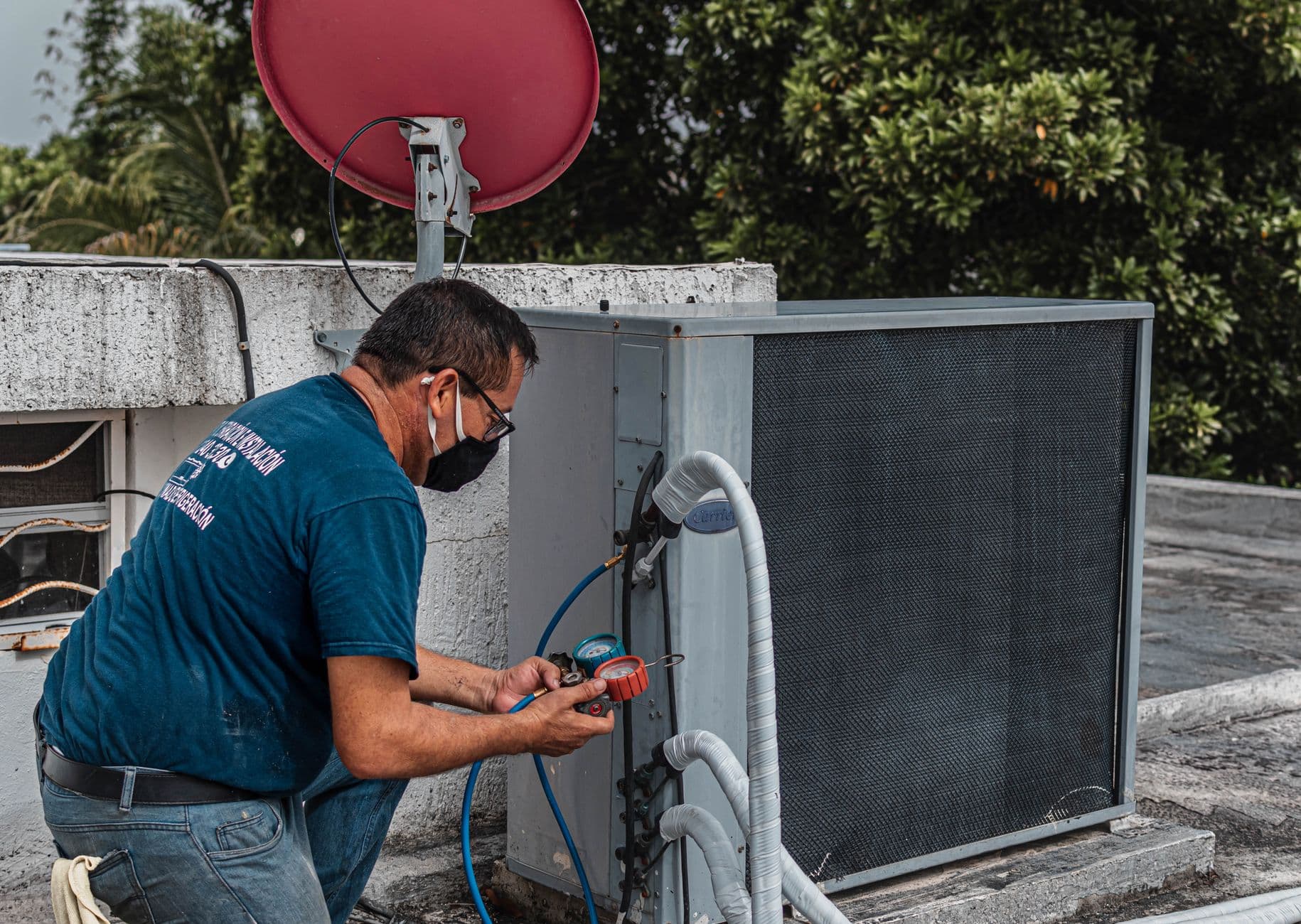
Photo by José Andrés Pacheco Cortes on Pexels
The Legal Basis: Section 608, 40 CFR Part 82, and the Subpart C Overlay
Section 608 of the Clean Air Act, implemented through 40 CFR Part 82 Subpart F, is the federal program that requires any person who maintains, services, repairs, or disposes of an appliance containing a regulated refrigerant to be certified. The rule has been in force in some form since 1995. In 2020 it was expanded to cover most non-exempt substitutes — including HFCs such as R-410A, R-404A, R-134a, and R-32 — so the rule now reaches essentially every commercial AC, refrigeration, and chiller system in service today.
40 CFR Part 84 Subpart C, effective January 1, 2026, does not replace Section 608. It layers on top of it. Subpart C expands recordkeeping duties for owners and operators of refrigerant-containing equipment, and several of its leak-repair, recovery, and disposal provisions explicitly require the work to be performed by a Section 608 certified technician. In practice this means an owner who fails to verify the credential is not only out of compliance under Part 82 — they are simultaneously out of compliance under Part 84.
Why the owner is on the hook: EPA has consistently taken the position that an owner who allows an uncertified person to open the refrigerant circuit on a stationary appliance has independently violated the regulation. The technician's lack of credentials does not insulate the facility — it implicates it.
For broader context on how Subpart C interacts with the existing Section 608 framework, see our companion piece on the Section 608 versus Subpart C comparison.
The Four Section 608 Certification Types
EPA recognizes four certification levels. A technician must hold the right type for the equipment in front of them — a Type I card does not authorize work on a rooftop unit, and a Type II card does not authorize work on a low-pressure chiller. Owners frequently miss this and assume any 608 card is enough; it is not.
| Type | Equipment Authorized | Typical Examples |
|---|---|---|
| Type I | Small appliances — factory-charged with five pounds or less of refrigerant and hermetically sealed | Domestic refrigerators, room air conditioners, vending machines, dehumidifiers, small under-counter ice makers |
| Type II | High-pressure and very high-pressure stationary appliances, excluding small appliances and MVAC | Residential and commercial split systems, supermarket refrigeration racks, packaged rooftop units, high-pressure chillers, walk-in coolers and freezers |
| Type III | Low-pressure stationary appliances | Centrifugal chillers using R-123, R-1233zd(E), and similar low-pressure refrigerants common in large commercial and institutional cooling plants |
| Universal | All of the above | A technician who has passed Type I, II, and III sections of the exam. The credential most service contractors prefer their journeymen to hold. |
A separate Section 609 certification covers motor vehicle air conditioning (MVAC). It is not interchangeable with the 608 program. A 609 card does not authorize work on a stationary appliance, and a 608 card does not authorize work on a passenger car system.
Section 608 certifications are issued for life. There is no renewal requirement at the federal level. That permanence is convenient for technicians but inconvenient for owners — it means a card can be decades old, and the holder may have moved on from refrigerant work long ago. Date of issuance is not, by itself, an indicator of competence.
Who Must Be Certified — and Who Does Not
The certification requirement applies to any person who, in the course of maintaining, servicing, repairing, or disposing of appliances, could be reasonably expected to violate the integrity of the refrigerant circuit. EPA reads "violate the integrity" broadly. The following activities trigger the requirement:
- Attaching and detaching hoses and gauges to measure pressure
- Adding or removing refrigerant to or from an appliance
- Brazing, welding, or otherwise opening lines
- Recovering refrigerant prior to disposal
- Performing leak inspections that involve opening the circuit
A few activities are not regulated and therefore do not require certification. These commonly cause confusion on a job site:
- Replacing a thermostat, a non-refrigerant-side electrical component, or an air filter
- Cleaning a condenser coil from the outside (no circuit access)
- Belt or motor replacement on the air-handler side
- Observing and visually inspecting an appliance without attaching instruments
The practical implication: an apprentice or helper can be on site and assist the certified tech, but the moment a hose is attached or a line is opened, a certified person must be the one doing it. EPA policy treats the certified technician as personally responsible for the integrity of the work performed under their supervision.
Owner-employee work: If your in-house maintenance staff perform any of the regulated activities — even on equipment owned by your own organization — they must hold the correct 608 type. Owning the equipment does not exempt your employees from the certification rule.
How Owners Actually Verify a Section 608 Certification
There is no central federal database an owner can query to look up a technician's certification. EPA does not publish a master list. Verification therefore relies on documentary review — and a few specific document features that distinguish a real card from a forged or expired one. The steps below reflect what a defensible verification process looks like.
1. Request a Photocopy or Photo of the Card
The card itself is the primary evidence. It should clearly state the certification type (I, II, III, or Universal), bear the technician's full name, show the issuing organization, and include a unique certification number. A "wallet card" with no issuing organization or no certification number is not acceptable evidence.
2. Confirm the Issuing Organization Is EPA-Approved
EPA publishes the list of approved Section 608 certification programs and the organizations that may administer the test. ESCO Institute, RSES, Mainstream Engineering, Ferris State University, and HVAC Excellence are among the long-recognized administrators. If the issuing entity is not on EPA's list, the credential is not valid regardless of how official the card looks.
3. Contact the Issuer to Confirm the Record
Most approved certifying organizations will confirm a current record on request when the technician's name and certification number are provided. This is the single most effective step for catching forged or revoked credentials. Service contractors who object to this step are flagging a problem with their workforce that you do not want to inherit.
4. Match the Type to the Equipment
A Type I tech showing up to service your rooftop unit is a compliance problem, even if the card itself is real. Confirm the equipment in scope falls within the type the technician holds. If a single tech will work across both rooftops and your centrifugal chiller, they need either Universal or both Type II and Type III credentials.
5. Retain a Copy in Your Vendor File
The verification is useless if it is not documented. Keep a copy of the card and a note of when you confirmed it with the issuer in the same place you keep your refrigerant service records. Subpart C's recordkeeping expectations are broad — see the dedicated guidance on § 84.106(l) recordkeeping requirements for what to retain and for how long.
Contractor Due-Diligence Checklist
Verifying one technician's card is necessary but not sufficient. Most refrigerant work in a commercial portfolio is done by a third-party service contractor whose technicians rotate. The due-diligence focus shifts from the individual to the firm — and to the contract terms that bind the firm to send only certified personnel.
A workable checklist for onboarding or renewing a refrigerant service contractor:
- Written certification roster. The contractor provides a list of every technician who may dispatch to your sites, with name, certification type, certification number, and issuing organization. Update annually.
- Section 608 technician certification clause in the service contract. The contract states explicitly that the contractor will not send an uncertified person to perform refrigerant work, that the contractor will produce the credential on request, and that misrepresentation is grounds for immediate termination.
- EPA Section 608 certified reclaimer / recovery-equipment language. Any recovered refrigerant must be processed by an EPA-certified reclaimer if it changes ownership. Recovery equipment used on your sites must be EPA-certified.
- Insurance and bonding evidence consistent with the work performed. Refrigerant releases can generate cleanup, equipment damage, and regulatory exposure that thin insurance does not cover.
- Sublet and substitution control. Many contractors sublet overflow work. The contract should require that any substitute or subcontracted technician meets the same Section 608 standard and that you receive their certification documentation in advance.
- Service-ticket capture of certified technician identity. Every work order should record the name and certification number of the technician who performed the work, not just the truck or dispatch number. This is the artifact an EPA inspector asks for first.
- Annual contractor compliance attestation. Have the contractor sign a yearly attestation that all technicians assigned to your account hold current Section 608 certifications of the correct type for the equipment they service.
For deeper coverage of service-contract language under the new regime, see our guidance on HVAC service contract requirements under Subpart C.
Penalty Exposure for Hiring an Uncertified Technician
The penalty framework is the same one that applies to other Section 608 and Part 84 violations: civil penalties under the Clean Air Act, adjusted annually for inflation, can reach over $120,000 per day, per violation. Each day a violation continues is a separate violation. Each piece of equipment serviced by an uncertified technician can be treated as a separate count.
EPA has pursued enforcement actions against both technicians and facility owners for Section 608 violations. The agency's posture in these matters has consistently been that an owner is not a passive recipient of contractor non-compliance — the owner has an independent duty to ensure only certified personnel touch the refrigerant circuit on its equipment.
Beyond the federal penalty, secondary consequences are material:
- Equipment warranty voidance. Manufacturers commonly require service by qualified, certified technicians as a condition of warranty. A claim made on equipment serviced by an uncertified person can be denied on the documentation alone.
- Insurance claim friction. Property and casualty underwriters increasingly request technician credentials as part of post-incident investigations. Gaps in this documentation extend claim cycles and create reservation-of-rights letters.
- State and local overlays. Several states impose their own contractor licensing requirements layered on top of Section 608. In California, for example, refrigerant work interacts with state-level reporting under the Refrigerant Management Program — see the California compliance overlay for how this affects vendor selection.
- Reputational and audit risk. A Section 608 finding tends to surface broader recordkeeping deficiencies once an inspector starts pulling files. The initial allegation rarely ends as a single-violation matter.
For the broader penalty picture and how multiple counts compound, see our reference on enforcement and penalty exposure under Subpart C.
Recordkeeping: What Owners Should Retain
Both Part 82 and Part 84 expect documentation to live with the owner. The technician's certifying organization holds the underlying record, but if an EPA inspector arrives on site, the inspector will ask the facility for evidence. A defensible owner file should include the following for each technician who has worked on the equipment in the prior three years:
- A legible copy of the technician's Section 608 card
- The certification type, certification number, and issuing organization
- A dated note of how and when the credential was verified (e.g., confirmation email from the issuer)
- A cross-reference linking the technician to the service tickets they performed
- Refrigerant added or removed during each service event, mapped to the certified technician on record
The retention period is at least three years under § 84.106(l), including three years after equipment retirement or disposal. For chiller plants and other long-lived assets, the practical retention horizon is the life of the equipment plus three years.
Spreadsheets and ad-hoc file folders rarely hold up across multi-site portfolios, contractor turnover, and three years of audit retention. RefriTrak™ keeps the link between a service event, the certified technician who performed it, and the credential on file — so when an inspector asks "who serviced this unit on April 12, and what's their 608 number?", the answer is a single lookup rather than a week of email archeology. That auditable chain is what an EPA inspector expects to see, and it's the difference between a clean closeout and a finding.
Training Resource Pointers for Technicians and In-House Staff
When a contractor cannot field a certified technician — or when an owner runs in-house maintenance and needs to certify staff — the following resources are the established starting points. They are either EPA-approved certifying organizations or industry training providers whose curricula prepare candidates for the certifying exam.
- EPA — Section 608 Technician Certification Programs: The current list of EPA-approved certifying organizations. Anyone administering a 608 exam must appear on this list.
- ESCO Institute (HVAC Excellence): Long-standing EPA-approved administrator. Offers online and proctored test options across all four certification types.
- RSES — Refrigeration Service Engineers Society: EPA-approved certifying organization with a national network of chapters that offer exam prep and proctored testing.
- Mainstream Engineering: EPA-approved certifying organization offering a well-known online testing pathway.
- Ferris State University: EPA-approved program popular for community-college-style classroom prep paired with proctored testing.
- Local community colleges and trade-school HVAC programs: Most include 608 exam preparation in the core curriculum and arrange proctored testing through one of the approved administrators.
For owners considering whether to bring routine service in-house, a common path is to sponsor existing maintenance staff through a Universal certification. The cost is modest compared with the contracted hourly rate for certified work — but owners should also weight the broader recordkeeping, recovery-equipment, and reclaimer obligations that come with operating any 608-regulated work program internally.
Putting It Together: A Practical Implementation Plan
For most multi-site owners, the verification program comes together in four passes. Each pass produces a tangible artifact that you can show to an inspector.
Pass 1 — Inventory the Equipment and Match Required Types
List every appliance subject to Section 608 and note which type of certification is required to service it. A site with rooftops plus a low-pressure chiller needs both Type II and Type III coverage, or a Universal-credentialed technician.
Pass 2 — Build the Vendor and Internal Technician Roster
For each active contractor and any in-house tech, collect the card image, certification number, type, and issuing organization. Confirm with the issuer for any credential you have not previously verified.
Pass 3 — Update Service Contracts and Work-Order Templates
Insert the 608 verification clause and the work-order field for the technician's certification number. Your future audit record depends on this capture happening consistently from the date of implementation forward.
Pass 4 — Annual Re-Attestation and Spot-Check
Once per year, re-confirm the contractor's roster and spot-check that the service-ticket data ties back to a verified certified tech. Periodic spot-checks are inexpensive and extremely effective at surfacing drift before an inspector does.
Owners running this program in conjunction with their full Subpart C owner compliance obligations tend to fold the certification roster into the same review cycle they already use for leak-repair documentation and recovery recordkeeping.
Frequently Asked Questions
Does a Section 608 certification expire?
No. At the federal level, Section 608 certifications are issued for life and do not require renewal. Some states and some employers impose their own currency or continuing-education expectations, but the EPA credential itself does not lapse with time. The owner's verification obligation, by contrast, should be repeated each year because the technician's employment status and assignment to your account can change.
Is a Section 609 (MVAC) certification acceptable for a rooftop air conditioner?
No. Section 609 is limited to motor vehicle air conditioning. A 609 card does not authorize work on stationary appliances of any kind. A technician working on your rooftop, split system, chiller, or walk-in must hold the appropriate 608 type, not 609.
What happens if my in-house maintenance worker has been servicing equipment without a 608 card?
Stop the unauthorized work immediately and get the employee scheduled for certification through an EPA-approved program. In the interim, use a certified contractor for any work that opens the refrigerant circuit. Document the change in process — EPA tends to be more receptive to owners who corrected a deficiency proactively than to those who did not act on it.
Do I need to verify the contractor's certification on every visit?
You do not need to physically inspect the card each time, but you do need to be able to demonstrate that every technician who touched your equipment was certified at the time of the work. The practical compromise most owners reach is to verify a roster annually, require the contractor to update you when a tech is added or removed, and capture the technician's identity and certification number on each service ticket.
Can a Type II technician work on a centrifugal low-pressure chiller?
No. Low-pressure equipment is the domain of Type III. A Type II certification does not extend to low-pressure machines. Centrifugal chillers using R-123 or R-1233zd(E) require Type III or Universal credentials. Allowing a Type II-only technician to perform regulated work on a low-pressure chiller is a violation.
How does verification interact with the new 40 CFR Part 84 Subpart C rules?
Subpart C does not create a new technician certification; it relies on the existing Section 608 framework. What Subpart C does is expand the owner's recordkeeping duties and tighten leak-repair, recovery, and disposal expectations. The practical effect is that the credential-verification work described in this article needs to be documented to a higher standard than was common practice before January 2026.
Related Resources
- Section 608 vs. Subpart C — What Changed and What Stayed — How the legacy program and the new Subpart C interact
- Recordkeeping Requirements Under § 84.106(l) — Including documentation owners must retain on technicians
- HVAC Service Contract Requirements Under Subpart C — Contract language that binds contractors to send certified techs
- Owner and Operator Compliance Obligations Under Subpart C — How technician verification fits into the broader owner duty set
- Enforcement and Penalty Exposure Under Subpart C — How penalties compound across equipment and days
Sources
- eCFR — 40 CFR Part 82 Subpart F (Section 608 Program)
- EPA — Section 608 Program Overview
- EPA — Section 608 Technician Certification Programs (Approved Administrators)
- EPA — Section 608 Frequent Questions
- eCFR — 40 CFR § 84.106 (Leak Repair and Recordkeeping Requirements)
- eCFR — 40 CFR Part 84 Subpart C (Management of Regulated Substances)
- EPA — AIM Act Enforcement
- Federal Register — Refrigerant Management Program Extension to Substitutes (2020)
- EPA — Stationary Refrigeration Leak Repair Requirements