Cold Storage and Walk-In Cooler Compliance Under 40 CFR § 84.106
The commercial refrigeration sector — third-party cold storage warehouses, supermarket racks, restaurant walk-ins, and convenience store remote systems — sits in a part of Subpart C where small differences in charge size, system architecture, and refrigerant chemistry determine whether the facility is fully regulated, partly regulated, or carved out entirely. This guide walks through the applicability threshold under § 84.106, the ammonia (R-717) treatment, the overlap with DOE walk-in equipment efficiency standards, and the leak detection escalation in § 84.108 for the largest systems.
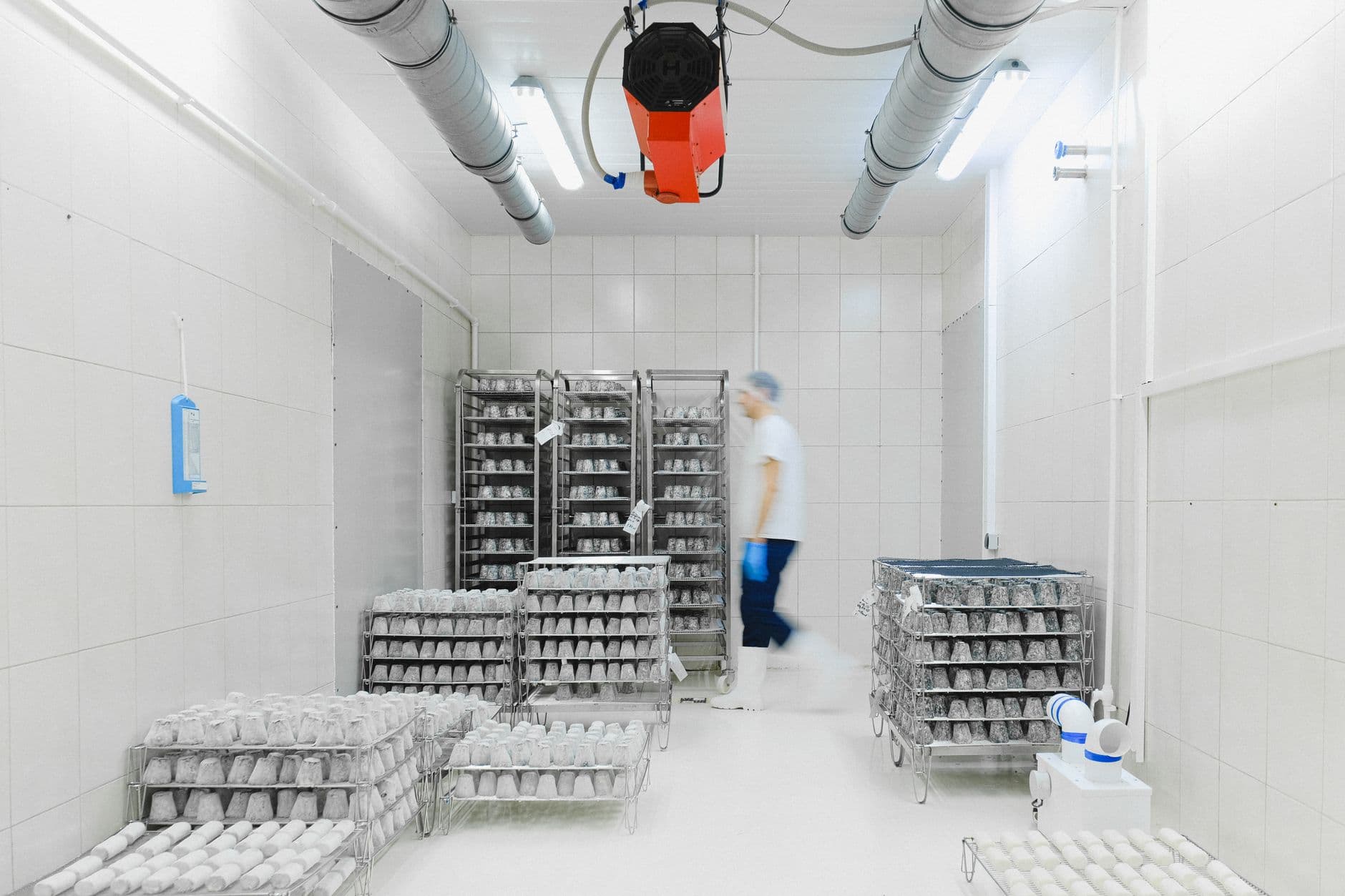
Photo by Anna Shvets on Pexels
Why Cold Storage and Walk-In Coolers Sit at the Center of Subpart C
Of every regulated sector under 40 CFR Part 84 Subpart C, commercial refrigeration is the one EPA cited most in its Technology Transitions rulemaking record as a primary source of HFC emissions in the United States. Supermarket direct-expansion rack systems alone account for a significant share of the country's commercial HFC inventory, with average charge sizes between 1,500 and 4,500 pounds per store. Cold storage warehouses — the third-party distribution facilities serving the food and pharmaceutical supply chain — are even larger, with single-system charges sometimes exceeding 50,000 pounds.
That concentration of regulated substance is the reason the leak rate limits, automatic leak detection requirements, and recordkeeping obligations in Subpart C apply with particular force to this sector. A 20 percent annualized leak on a 3,000-pound rack releases 600 pounds of HFC. At a CO2e-weighted GWP of 1,924 for R-404A, that is roughly 524 metric tons of CO2 equivalent from a single store in a single year — an emissions footprint comparable to burning 130,000 gallons of diesel.
The flip side is that not every walk-in is in scope. Restaurants with a single 8-pound R-404A walk-in cooler and a separate 12-pound freezer are not subject to § 84.106 leak management at all. The dividing line is the 1,500-pound commercial threshold, and most of the compliance questions in this sector start with applying that number correctly.
The § 84.106 Applicability Threshold for Commercial Refrigeration
Section 84.106 imposes leak management obligations — leak rate calculation, repair within 30 days, retrofit/retirement planning, recordkeeping, and verification testing — on three categories of appliance, distinguished by full refrigerant charge and end-use sector:
| Sector | Charge Threshold | Annualized Leak Rate Limit |
|---|---|---|
| Commercial refrigeration (cold storage warehouses, supermarkets, walk-ins, refrigerated cases) | ≥ 1,500 lbs | 20% |
| Industrial process refrigeration (food processing, chemical, pharmaceutical chillers) | ≥ 1,500 lbs | 30% |
| Comfort cooling (commercial HVAC chillers, building AC) | ≥ 1,500 lbs | 10% |
Two points trip up cold storage and walk-in operators most often. First, the threshold is per appliance, not per facility — and EPA defines "appliance" as a system with a closed refrigerant circuit. A supermarket with a low-temperature rack of 1,200 pounds and a medium-temperature rack of 1,000 pounds operates two distinct appliances, both below the threshold. The same store operating a single 2,200-pound rack feeding both temperature zones is one appliance over the threshold.
Second, the classification between "commercial refrigeration" and "industrial process refrigeration" matters because the leak rate limit differs by 10 percentage points. A frozen food distribution warehouse is commercial refrigeration. A frozen food manufacturer using ammonia or HFC systems to chill product as part of a manufacturing process is industrial process refrigeration — assuming the refrigerant is not ammonia, which is exempt entirely. The end-use sector determination is fact-specific and often turns on whether the cooled space stores finished product (commercial) versus conditioning a process stream (industrial).
For the foundational rules on charge counting and sector classification, see the dedicated guide on § 84.106(a) applicability and the 1,500-pound charge threshold.
Walk-In Coolers in Restaurants and Convenience Stores
A single quick-service restaurant typically operates one walk-in cooler (35°F) and sometimes a walk-in freezer (−10°F), each as a self-contained appliance with a charge between 4 and 20 pounds. A full-service restaurant with prep, beverage, and finished-product coolers may run three or four small systems totaling under 100 pounds. None of these systems individually crosses the 1,500-pound threshold, and EPA does not aggregate charge across independent systems at the same site.
The compliance picture changes for convenience stores running remote condensing units. A typical large-format convenience store with beer caves, frozen food cases, dairy walk-ins, and ice cream cases may operate on a single rack with a charge between 400 and 900 pounds — still below the threshold but trending upward as store footprints grow. Once a single connected appliance crosses 1,500 pounds, the full § 84.106 regime activates: annualized and rolling-average leak rate tracking, 30-day repair windows after a threshold exceedance, and three-year recordkeeping.
Practical takeaway: A single-location restaurant owner with stand-alone walk-ins is almost certainly out of scope for § 84.106 leak management — but still subject to refrigerant handling rules under 40 CFR Part 82 Subpart F (technician certification, sales restrictions, prohibition on knowing venting during service). Subpart C does not replace those baseline rules; it sits on top of them for larger systems.
For sites at the borderline — large convenience store chains and multi-unit restaurant groups with central commissary refrigeration — the practical question is whether to design new builds intentionally to stay below the threshold (multiple smaller circuits) or above it (one centralized system, accepting the compliance overhead). That decision frequently turns on capital expense, refrigerant choice, and the planned service lifetime. See retrofit and retirement decision-making under § 84.106 for the framework on aging system economics.
Cold Storage Warehouses: Charge Sizes That Always Trigger § 84.106
Third-party cold storage warehouses — including those operated by the major refrigerated-logistics providers — run charges that almost always exceed the 1,500-pound threshold for any HFC system in service. A single mid-size facility (200,000 to 500,000 cubic feet of refrigerated and frozen space) on an HFC platform typically carries 3,000 to 12,000 pounds of charge per system. Multi-tenant mega-facilities can hold 30,000 pounds or more in a single consolidated rack.
For HFC-charged cold storage at this scale, the practical compliance posture is to assume § 84.106 applies in full and build the program around it from day one:
- Annualized leak rate calculation: Each refrigerant addition must be tracked by date, system, and quantity. The rolling 12-month leak rate must be calculated at least every time refrigerant is added and reviewed against the 20 percent threshold.
- Initial verification on installation: Newly installed or retrofitted appliances ≥ 1,500 lbs require an initial verification test before the appliance is placed back into service.
- Repair window: Once the leak rate exceeds 20 percent, the owner has 30 days to repair leaks and conduct follow-up verification, with a documented retrofit or retirement plan required if repairs fail.
- Automatic leak detection (ALD): Industrial process refrigeration appliances ≥ 1,500 lbs require ALD under § 84.108. For commercial refrigeration, ALD becomes mandatory above the higher threshold set in § 84.108 for that sector. Most modern supermarket and warehouse builds install ALD anyway as a loss-prevention measure.
- Recordkeeping: Service records, leak test results, calculations, verification tests, and chronic leak documentation must be retained for three years, and three years after equipment retirement.
For the threshold-driven detection requirements specifically, see automatic leak detection requirements under § 84.108, which covers the equipment standards, calibration intervals, and alarm response obligations that overlay § 84.106 for the largest appliances.
The Ammonia (R-717) Carve-Out — and What Replaces It
Ammonia is not a regulated substance under the AIM Act. The AIM Act targets hydrofluorocarbons specifically, and Subpart C derives its scope from the AIM Act's definition of "regulated substance." Ammonia (R-717) has a global warming potential effectively at zero and is not on the list. That makes any ammonia refrigeration appliance — regardless of charge size — outside § 84.106 leak management entirely.
Ammonia is, however, a high-hazard chemical with toxicity and flammability concerns, so it is regulated under a separate framework that often imposes obligations more demanding than Subpart C:
| Regulation | Threshold | What It Covers |
|---|---|---|
| OSHA Process Safety Management (29 CFR 1910.119) | ≥ 10,000 lbs of anhydrous ammonia | Process hazard analysis, mechanical integrity, management of change, emergency response |
| EPA Risk Management Program (40 CFR Part 68) | ≥ 10,000 lbs of anhydrous ammonia | Hazard assessment, prevention program, emergency response plan, RMP submission |
| EPCRA Section 304 (40 CFR Part 355) | 100 lbs reportable quantity for ammonia release | Immediate notification of LEPC and SERC on release ≥ RQ |
The practical implication is that ammonia cold storage and food processing facilities still maintain extensive refrigerant documentation — but it is PSM documentation, RMP documentation, and incident reporting documentation rather than § 84.106 leak rate calculations. Operators contemplating a switch from HFC platforms to ammonia for new builds gain relief from § 84.106 obligations but take on the substantial overhead of an OSHA PSM program at the 10,000-pound charge threshold.
CO2 (R-744) and propane (R-290) cascades — the other two natural refrigerants now common in supermarket and walk-in applications — also fall outside the AIM Act's definition of regulated substance. They carry their own safety codes (ASHRAE 15, UL 60335-2-89 for R-290 charge limits in self-contained units) but are not subject to § 84.106 leak rate management.
The DOE Walk-In Efficiency Standard Overlap
Walk-in cooler and walk-in freezer operators frequently confuse the Department of Energy walk-in efficiency standards with EPA refrigerant rules. They are two distinct regulatory regimes that touch the same equipment at different lifecycle points:
| Dimension | DOE Walk-In Standards (10 CFR Part 431) | EPA § 84.106 Leak Management |
|---|---|---|
| Regulates | Energy efficiency at point of manufacture/sale | Refrigerant management during operation |
| Who must comply | Equipment manufacturers, importers, and assemblers | Equipment owners and operators |
| Metrics | Annual Walk-in Energy Factor (AWEF), panel R-values, refrigeration system efficiency, evaporator fan controls | Annualized leak rate (%), full charge size, verification testing |
| Trigger | All new walk-ins manufactured for U.S. commerce | Appliances with ≥ 1,500 lb HFC/HFO charge |
| Enforcement | DOE certification reports, manufacturer civil penalties | EPA inspections, civil penalties up to ~$125K per day per violation |
The two regimes do not cross-reference each other, but they frequently push design decisions in the same direction. DOE-compliant walk-in refrigeration systems prioritize variable-speed compressors, electronic expansion valves, and tight refrigerant charge control — all of which also reduce the likelihood of crossing the § 84.106 leak rate trigger. A walk-in that is properly engineered for AWEF compliance is less likely to leak chronically, and a walk-in that leaks chronically is by definition operating well outside its designed AWEF.
Operators upgrading walk-ins for DOE efficiency compliance should treat the upgrade as a natural inflection point for refrigerant platform decisions under Subpart C. If a 1990s-vintage R-22 walk-in is being replaced for efficiency reasons, the replacement choice (R-448A, R-449A, R-290 self-contained, or CO2) determines the entire compliance posture for the next decade.
Refrigerant Choice for New Cold Storage and Walk-In Builds
For commercial refrigeration appliances installed in 2026 and later, EPA's Technology Transitions rules under 40 CFR Part 84 Subpart B restrict refrigerants by GWP. The interaction between Subpart B (technology transitions / GWP limits at install) and Subpart C (leak management once installed) drives most current new build decisions:
| Refrigerant | GWP | Typical Use | Subpart C Status |
|---|---|---|---|
| R-404A | 3,922 | Legacy supermarket racks, walk-in freezers | In scope; new installs restricted by Subpart B |
| R-448A / R-449A | ~1,400 | Current standard supermarket retrofit and new build HFC/HFO blends | In scope at ≥ 1,500 lbs |
| R-454C / R-455A | 148 / 146 | Lower-GWP A2L blends for new commercial refrigeration | In scope at ≥ 1,500 lbs |
| R-290 (propane) | 3 | Self-contained reach-ins, small walk-ins, charge-limited per UL 60335-2-89 | Not a regulated substance |
| R-744 (CO2) | 1 | Transcritical and cascade supermarket and cold storage systems | Not a regulated substance |
| R-717 (ammonia) | 0 | Industrial cold storage, food processing | Not a regulated substance |
For a deeper look at how end-use sector classification affects which GWP limits and effective dates apply, see the guidance on building types and end-use applicability under Subpart C.
Recordkeeping for In-Scope Cold Storage and Supermarket Operators
For any appliance in the regulated set, § 84.106(l) requires retention of records sufficient to reconstruct the leak management history of each appliance. At an audit, EPA typically asks for the following on request:
- Equipment inventory: Every appliance ≥ 1,500 lbs, with location, system identifier, refrigerant type, full charge size, and how that full charge was determined (nameplate, manufacturer specification, commissioning measurement).
- Refrigerant transaction log: Every addition and removal, with date, technician, quantity, and reason (top-off, service, retrofit, retirement).
- Leak inspections: Documentation of required leak inspections, including method (electronic detector, soap bubble, ultrasonic), inspector identity, and findings.
- Repair documentation: Identified leak locations, repair actions, parts replaced, follow-up testing.
- Leak rate calculations: Both annualized rolling and quarterly running calculations, with documentation of the calculation method.
- Verification testing: Initial and follow-up verification tests after repairs, including test method and result.
- Retrofit/retirement plans: Where repair fails to return the appliance below the leak rate threshold, the written retrofit or retirement plan and the timeline for completion.
Multi-site cold storage and supermarket operators frequently underestimate the records burden until an audit notice arrives. A 200-store chain with a single 2,000-pound rack per location runs 200 in-scope appliances, generating thousands of refrigerant transaction events per year and tens of thousands of records to retain for at least three years per the rule. For a full breakdown of what records are required and what an audit-ready file looks like, see the dedicated guide on recordkeeping requirements under § 84.106(l).
Operationalizing Compliance Across a Multi-Site Cold Storage or Retail Portfolio
The compliance posture for a single 30,000-pound cold storage warehouse and a 200-store supermarket chain look superficially different — one large system, many medium systems — but the underlying records are the same: appliance inventory, transaction log, leak rate calculation, verification, retention.
At a single site, spreadsheets and service invoices are sometimes adequate. Across a portfolio, they almost never are. The arithmetic breaks down the moment one technician is filling on Tuesday at one location while another is rolling-average calculating across the chain on Friday. Many equipment owners use specialized refrigerant compliance software to automate recordkeeping obligations. These systems capture service data from technician work orders, calculate annualized and rolling leak rates automatically per appliance, flag threshold exceedances before they generate enforcement exposure, and maintain searchable electronic records meeting the three-year retention requirement under § 84.106(l). For cold storage and supermarket operators managing dozens or hundreds of in-scope appliances, the practical value is not the calculation itself but the visibility — knowing on Monday which appliance is trending toward a threshold rather than learning on Friday that one already crossed it.
Enforcement Posture for the Cold Storage and Supermarket Sector
EPA has historically pursued enforcement actions in the commercial refrigeration sector under the predecessor § 608 leak repair rule, and there is no indication that the agency will be less attentive under Subpart C. The leak rate threshold is lower (20 percent vs the former 35 percent), the recordkeeping is more granular, and the maximum civil penalty per day per violation is higher than under the § 608 regime.
The most common enforcement triggers EPA has cited in this sector include:
- Failure to repair within 30 days of a threshold-exceeding leak rate calculation;
- Failure to calculate annualized leak rate at the point of each refrigerant addition;
- Refrigerant transaction records that cannot be reconciled to service invoices or reclaimer manifests;
- Missing initial verification test documentation after appliance installation or retrofit;
- Chronic leakers (appliances repeatedly above the threshold) with no documented retrofit/retirement plan.
For a closer look at how penalty amounts are calculated and how EPA has framed enforcement priorities under the new rule, see enforcement and penalty structure under Subpart C.
Frequently Asked Questions
Does § 84.106 apply to walk-in coolers in restaurants and convenience stores?
It depends on the charge of the appliance. Most stand-alone restaurant walk-ins hold under 25 pounds and fall well below the 1,500-pound threshold. Multi-rack supermarket and large convenience store remote systems often exceed it, which brings the full leak management regime — annualized leak rate calculation, 30-day repair window after a threshold exceedance, and three-year recordkeeping — into play.
Is ammonia (R-717) refrigeration covered by 40 CFR Part 84?
No. Ammonia is not a regulated substance under the AIM Act, and Subpart C does not apply to ammonia systems regardless of charge size. Ammonia refrigeration is governed primarily by OSHA PSM (29 CFR 1910.119), EPA RMP (40 CFR Part 68), and EPCRA release reporting — frameworks that often impose deeper documentation and response obligations than Subpart C.
How does § 84.106 interact with DOE walk-in efficiency standards?
They are parallel regimes. DOE's walk-in efficiency standards under 10 CFR Part 431 regulate equipment at the manufacturer/sale level — AWEF, panel R-values, fan controls. EPA § 84.106 regulates refrigerant management once the equipment is installed and operating. A walk-in must satisfy DOE at manufacture and § 84.106 during operation if its system charge crosses 1,500 pounds.
What is the leak rate limit for a cold storage warehouse?
Commercial refrigeration appliances ≥ 1,500 lbs are subject to a 20 percent annualized leak rate limit under § 84.106. Industrial process refrigeration appliances (e.g., chillers integrated into a manufacturing process) face a 30 percent limit. Comfort cooling appliances are subject to the strictest limit at 10 percent. Sector classification is fact-specific and is the first compliance question for facilities with hybrid uses.
Are convenience store remote condenser systems treated as one appliance?
If they share refrigerant circulation — a single rack feeding multiple cases and walk-ins — yes, EPA treats them as one appliance for charge counting purposes. Two independent systems at the same site are counted separately. This makes system architecture (one big rack vs. several smaller circuits) a compliance design decision, not just an engineering decision.
What records must a cold storage facility keep under § 84.106(l)?
Equipment identification, location, full charge size and its determination method, every refrigerant addition with date and quantity, leak inspection results, repair documentation, leak rate calculations, and verification test results. Records must be retained for at least three years, and three years after equipment retirement. EPA expects records to reconcile with service invoices and reclaimer manifests during audit.
Sources
- eCFR — 40 CFR § 84.106 (Leak Repair Requirements)
- eCFR — 40 CFR § 84.108 (Automatic Leak Detection Requirements)
- eCFR — 40 CFR Part 84 Subpart C (Management of Regulated Substances)
- EPA — Final Rule: Management of Regulated Substances (Emissions Reduction & Reclamation)
- EPA — Final Rule: Technology Transitions Program (40 CFR Part 84 Subpart B)
- eCFR — 10 CFR Part 431 Subpart R (Walk-In Cooler and Walk-In Freezer Equipment)
- OSHA — 29 CFR 1910.119 (Process Safety Management of Highly Hazardous Chemicals)
- eCFR — 40 CFR Part 68 (Chemical Accident Prevention Provisions / Risk Management Program)
- EPA — Section 608 Refrigerant Management Program (predecessor framework)
- DOE — Walk-In Coolers and Walk-In Freezers Standards Program